Showing posts with label gardening. Show all posts

Monday, November 17, 2014

Bloomin' Bulbs Beat Winter Blahs

Coaxing spring-flowering bulbs to bloom during the winter is a popular trick for adding brilliant color to the home and a welcome boost to the spirit. Unfortunately, the trick does not work well for everyone, while even successful practitioners often look at the faded foliage and wonder what next?

The process of "forcing" bulbs simply means inducing plants to bloom ahead of schedule and out of their normal environment. This horticultural chicanery can be applied to almost any bulb, corm, or tuber, although the easiest subjects for beginners are generally paperwhite narcissus, fragrant hyacinth, large-flowering crocus, and amaryllis, the largest, showiest, and most versatile of the lot.

Other, slightly more difficult species include muscari, like grape hyacinths, colchicum, such as autumn crocus, snowdrops, freesia, and sweet-and- spicy Lily-of-the-valley.

Tulips and traditional garden daffodils are a bit more finicky, requiring better temperature control, brighter lighting, and so on, although many catalogs and gar- den centers will advertise some species more suitable for forcing, such as miniature hybrids that are more at home on windowsills.

Paperwhites (Narcissus tazetta) are especially popular, as they can be planted in either a light, porous soil mix or, more commonly, in shallow glass bowls or other attractive planters, using nothing more than a layer of water in clear or colored marbles, or pastel-tinted gravel, easily found at aquarium stores.

These narcissi are noted for their thin, delicate foliage and clusters of fragrant white flowers. Some indoor gardeners will plant clusters of five, seven, or more bulbs every two weeks or so to ensure an ongoing aromatic display throughout the holidays and late winter months.

Regrettably, these easy-to-grow paperwhites are native to the Mediterranean, and are not tolerant of our colder climate. Except for gardens in warmer zones from nine onward, the usual advice is to discard the bulbs. Personally, I would prefer taking a chance on planting them outdoors after the foliage has yellowed and died-back, rather than merely adding them to a compost pile. At any rate, the bulbs will have exhausted their energy reserves and cannot be saved for forcing again the following year, which is true of almost all forced bulbs.

On the other hand, you might try forcing a related narcissus species called Grand Soleil d'Or, which offers a deep yellow color with somewhat smaller clusters of blooms. These narcissi can be transplanted to your garden later in the fall and should provide a decent showing the following summer, improving each year thereafter.

The key to success with forced bulbs is keeping your cool - or, at least, keeping bulbs cool while they are rooting. And while there is a whole science to buying and storing bulbs in refrigerated conditions, any number of retailers offer "hardened- off" bulbs which have gone through the appropriate chilling process and are ready for forcing.

With these ready-to-go bulbs, you can select a number of planting options. Hyacinth or forcing jars are specially designed glass vessels appropriate for crocus, narcissus, or, naturally, hyacinths, which artfully support the entire bulb, allowing the roots to dip down into the water below. You can also employ a gravel medium for paperwhites, crocus, or colchicum, or plant them in a soil mix. For these and all other bulbs, use a shallow "bulb pan" with a loose potting medium of equal parts of soil, compost or peat moss, and vermiculite or perlite. Many bulb fanciers like to add a pinch of bone meal per bulb. A four-five inch pot works well for larger single bulbs like hyacinths, while a six-ten inch pot accommodates several large bulbs or a dozen smaller bulbs.

Keep species forced in water or set in gravel in a cool, dark room (ideally below 50 degrees F.) for at least several weeks, until the root system has become thoroughly established and the top shoot or stems start to elongate.

Soil-planted bulbs will also require cold storage at 35-48 degrees F. while roots are developing. Never allow bulbs to freeze, and keep the temperature below 55 degrees. The best locations are usually an unheated cellar, enclosed garage, insulated cold frame, or refrigerator. In a refrigerator, it is best to cover the pot with a plastic bag punched with several holes for ventilation. Keep the planting medium moderately moist. The length of chilling time required depends on the species, but usually averages 12-16 weeks. The longer the bulbs remain cool, the taller and fuller their flowers will be.

A fundamental mistake in forcing bulbs is skimping on the cold treatment. Often if bulbs fail to bloom, it is an indicator that the retailer did not allow the bulbs to remain dormant long enough, the bulbs were stored at too high a temperature, or the forcing temperature was too high.

After the bulbs have been chilled appropriately, move them into a somewhat warmer room (50-60 degrees F.) with indirect light for a week or so, until shoots or stems elongate and the buds begin to swell. It is now safe to move the pot into a bright window at normal indoor temperatures.

To keep the blooms for the longest possible period of time, it helps to move the pot into a cooler room in the evening and avoid direct sunlight.

After your bulbs have finished blooming, cut off the flower stalk above the base, but not the leaves! Treat your forced bulbs like a typical indoor plant, with bright light, periodic watering and fertilizing, all of which will help the bulb renew its energy stores for future growth and blooming.

Do not remove the foliage as it begins to yellow and wither, but do reduce watering significantly until all of the leaves have died back. At that point, as your bulbs enter their dormant phase, you should allow the soil to completely dry out, and either save the bulbs in their pots or, especially in the case of water-forced species, remove the bulbs or corms, gently rubbing them clean with a dry cloth, and store them in a cool, dry, and dark place in a mesh bag or paper bag, keeping a vigilant eye out for mold.

In the fall, these bulbs can be planted in your garden. Pay attention to required planting depths. Bulbs cultured in soil generally fare better than those in forcing jars or gravel, but within one, two, or more seasons, your bulbs will return to full bloom in their new, natural outdoor environment.

Copyright 2014, Joseph M. Keyser

Friday, September 19, 2014

"Mums" the Word

Shorter days -- cooler nights.  Perhaps you've noticed.  Fall is fast upon us!  Not surprisingly, a recent visit to my neighborhood Whole Foods market was greeted by an exuberantly colorful sight. Mums. Mountains and mounds of them. And how timely. After all, as the sun slips lower in the sky, we'll find a new kind of light. An "autumn light" which is mellow, warm and golden, and almost seems to glow across our landscape. Gardeners, looking to respond to that gentle light, will find no plant which can echo the gentle colors of fall more kindly and completely than the chrysanthemum.

The chrysanthemum is often called the “queen of fall flowers,” and is actually the largest commercially produced flower in the United States, both as a potted plant, and in floral arrangements, where chrysanthemums are valued as one of the longest lasting cut flowers.
Mums are members of the Asteraceae (or Compositae) family, the largest family of flowering plants, and is related to asters, dahlias, marigolds, zinnias, and most other daisy-like flowers. A closer look at a plant will reveal that the single bloom is actually made up or “composed” (hence Compositae) of hundreds of small flowers or florets, with ray florets on the outer edge of the flower, and disk florets at the center of the blossom.

The origins of the mum take us to China at least as far back as the 15th Century B.C., where the plant was cultivated as a flowering herb for use in salads, brewing beverages for special celebrations, and curing headaches, possibly caused by those celebrations.

Please note that only the flower petals of today’s ornamental mums are edible. While there is an edible chrysanthemum called garland or vegetable chrysanthemum (Chrysanthemum coronarium), with leaves reminiscent of today’s ornamental variety, hungry gardeners should not attempt to eat the foliage of garden chrysanthemums.

During the eighth century A.D., chrysanthemums began to appear in the literature and art of Japan. Called Ki-Ku, “Queen of the East,” a single blossom of the flower was used as the crest of the emperor, and Chrysanthemum Throne is the common name for the Imperial Throne. Today, chrysanthemum is the national flower of Japan.

Chrysanthemums gained attention in the West in the 17th century, and were so-named by the botanist Linnaeus who combined the Greek “chrysos” with “anthemon” to describe a “golden flower.”

Of course, mums are a lot more than golden flowers these days. Horticultural breeding now provides a dizzying variety of forms, colors, and growth habitats. The National Chrysanthemum Society recognizes 13 different classes of mum, many of which are familiar to gardeners, such as spider, anemone, quill, spoon, and pompon, although marketing efforts also tout mums with fanciful names such as football mums, maxi-mums, pin cushion, and many more.

Beyond interesting floral shapes, these jewels of autumn are resplendent in russets and gold, red, yellow, gold, orange, pink, purple and white, and can be planted in solid masses of color, or mixed together like a living tapestry.

Of special interest is a fairly recent and popular mum, ‘Silver and Gold,’ which provides variegated foliage along with attractive blooms and desirable winter hardiness.
Chrysanthemums can be sited almost anywhere in the landscape, in planters by a front door, as border plantings along a driveway, or mixed into a year-round garden bed to provide a quiet splash of color.

Planted in beds around and beneath trees, the colors you select can mirror or complement the seasonal color of the leaves overhead. Above all, the mums can provide a dramatic climax for your landscape before the arrival of winter.

However, before you run off to your local supermarket to pick up your bounty of mums, you should consider a few important details. Most important of all, be sure to select hardy garden mums, not the foil-wrapped, potted florist mums. The mums commonly given as housewarming gifts are probably not winter hardy, and also tend to become quite tall, and will provide few blooms beyond the care and feeding of a greenhouse manager.

Instead, turn to a reputable garden center, where the mums are already somewhat acclimated to cooler temperatures, and where the plants were initially bred for use as perennials. Seek advice from a staff horticulturist if you are uncertain about your selection.

You will want to ensure that your mums will receive about six hours of sun, and should be planted in organically-rich, well-drained soil. Consider improving your soil by adding compost and prepare the planting bed eight to 12 inches deep.

After planting, water the mums thoroughly and water weekly thereafter, carefully avoiding wetting the foliage which can cause mildew. After the flowers have faded, snip off spent blooms and mulch the bed with shredded leaves or shredded hardwood mulch about three inches thick.

Keep in mind that there may be some losses if the winter months are especially harsh. Generally, spring-planted mums have a better survival rate than those planted in fall, but proper care can make a significant difference.

In early spring, pull back the mulch to allow new shoots to emerge and prune back old stems to the ground. After plants start growing fully, pinch back about four inches of growth every three to four weeks until July to encourage bushy growth, a full head of flowers, and an autumnal blooming period.

Every other spring, starting in about two years, divide your mums by digging up the entire plant, then use a sharp knife to separate well-rooted outer pieces from the original plant. Space out and replant the new pieces, and send the old woody core to the compost pile.

Interestingly, you will find that chrysanthemums seldom receive the recognition they deserve. For example, Preakness fans think they are seeing the winning horse and rider presented with a blanket of Black-eyed Susans. Not so! Those flowers are actually mums, substituted for the summer-blooming Maryland state flower.

A rose by any other name? You will also find that there are few roses adorning those colorful floats in the Rose Bowl Parade in Pasadena. Instead, delighted viewers are enjoying a kaleidoscope of mum blossoms and petals. But mums the word on that!

For more information on growing and appreciating mums, turn to the National Chrysanthemum Society and their website: www.mums.org.

Copyright 2014, Joseph M. Keyser

Friday, August 15, 2014

Getting Close to Cloisters

A garden can play many roles in our lives, depending on its design and intent: a treat for the senses, a source of sustenance, or a simple place to mess about with plants. But certainly one of the most important and traditional roles is as a unique place away from the world and worldly concerns. This special sort of garden can serve as an area for reflection, meditation, and spiritual healing. Indeed, for many of us, while we acknowledge having lost Eden, we haven’t given up on trying to recreate an ideal space for body and soul.

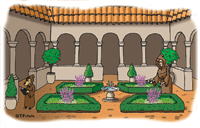
Perhaps no finer model for this meditation garden exists than the great monastic gardens which flourished for more than a millennium. By their very nature, these cloistered gardens were physically separated from the outside world by walls and roofed arcades, allowing visitors to focus within: both on the inner features of this peaceful garden, with its tranquil fountain, fruit trees, and healing herbs – and, more importantly, within themselves.

In fact, the very act of enclosing a garden reflects an almost primal understanding of what a garden is. For fun with philology, we can look to the etymology of “garden” and find the proto Indo-European root word “ghor-dho,” which means “enclosure.” (That word is also related to “yard” and the Latin hortus, as in horticulture.) Perhaps more interesting, medieval cloistered gardens were often called paradise gardens, hearkening back to Eden, with the word “paradise” coming to the West as pairidaeza, from the Old Persian, also meaning “walled enclosure.” The West, after all, did not have a monopoly on enclosed gardens.

To create a true garden meant separating your plants – and your person – from the world outside. And as our world is no more peaceful than that of the abbots who created the Benedictine and Cistercian monasteries, perhaps we might just want to return to the notion of a cloistered garden of our own.

Naturally, your three bedroom colonial might not easily lend itself to the addition of a finely cut stone-walled quadrangle, but you can at least separate your meditative space from the rest of your landscape with a simple wooden fence, trellises, arbors, or a planting of shrubs. You’re simply looking for a private inner space where you can turn within.

Following the lead of the monastic gardens, which typically observed a formal layout of rectangular beds and pathways, you might want to establish raised beds, another common medieval feature, in which to cultivate herbs and vegetables. After all, St. Benedict in the 6th century required that his monks provide all their own “necessaries” within the walls of their monastery. Not unlike the Victory Gardens of the 1940s.

Herbs were especially important to the monastic garden, as any fan of the Brother Cadfael mysteries knows. Medicinal plants were at the heart of monastic life, where monks studied and recorded the therapeutic properties of roots, dried leaves, and fruits, thereby institutionalizing modern pharmacology, much as the abbeys laid the groundwork for hospitals. Consider a quick visit to a public herb garden to identify medicinal and other herbs for your garden. You will be surprised that key medieval herbs are still favorites today.

Fruit trees, another symbol of paradise (munching on which led to man’s expulsion), were common features in almost all medieval gardens, and might adorn your garden, as well. Of course, barring the presence of a serpent, you should feel free to enjoy any of the apples or plums that you grow.

And while planning your bit of backyard paradise, remember that fragrance can stir memory and reflection, much as incense is used in both Eastern and Western religious traditions. Depending on your taste, you might plant soft musky-scented English boxwoods as a formal edge to your pathways, or choose from the palette of native shrubs and vines such as buttonbush or arbor-loving virgin’s bower.

The center of your garden should host a single, strong element, whether a trickling fountain, birdbath, or piece of sculpture. Original medieval works are probably out of the question, but concrete knock-offs of the Irish St. Fiacre (patron saint of gardeners) can be found in various garden shops, especially those associated with cathedrals, naturally.

Lastly, remember to set aside an area where you can actually sit and enjoy – and use – your meditation garden. That means setting aside time as well. The world goes along in its bumpy chaotic way, but you can still find a peaceful retreat and solace for your soul in paradise, even if it’s only in your backyard.

A personal note on cloistered gardens:
I strongly believe that at one time or other, nearly everyone has been profoundly influenced by a special place or an experience of place. For a young kid from Brooklyn, that place was the Cloisters in New York, the Metropolitan Museum of Art’s world-renowned and truly staggering collection of medieval art. The Cloisters is a museum woven around five actual monastic gardens disassembled and reassembled stone-by-stone in Ft. Tryon Park, overlooking the Hudson River. At around age 12, I experienced the Cloisters for the first time with my father one late winter’s day. I remember the scent of lemon and orange blossoms from potted trees dotting the glass-screened arcades; the burbling sound of fountains competing with Gregorian chant echoing through the complex. That single visit ultimately led to my educational life as a medievalist, my vocation as a horticulturist, and created a cultural passion that informs each and every moment of my life. Today, my wife (a medievalist) and I are on the verge of planning the construction of my dream home: it will have bedrooms, a kitchen, library, and all the rest – and it will be built around a central courtyard, a garden, with herbs and fruit trees and fountains. Evidently some places change you forever.

Copyright 2014, Joseph M. Keyser

Saturday, December 03, 2011

Big, Bloomin' Bulbs in Winter!

Coaxing spring-flowering bulbs to bloom during the winter is a popular trick for adding brilliant color to the home and a welcome boost to the spirit. Unfortunately, the trick does not work well for everyone, while even successful practitioners often look at the faded foliage and wonder what next?

The process of "forcing" bulbs simply means inducing plants to bloom ahead of schedule and out of their normal environment. This horticultural chicanery can be applied to almost any bulb, corm, or tuber, although the easiest subjects for beginners are generally paperwhite narcissus, fragrant hyacinth, large-flowering crocus, and amaryllis, the largest, showiest, and most versatile of the lot.

Other, slightly more difficult species include muscari, like grape hyacinths, colchicum, such as autumn crocus, snowdrops, freesia, and sweet-and- spicy Lily-of-the-valley.

Tulips and traditional garden daffodils are a bit more finicky, requiring better temperature control, brighter lighting, and so on, although many catalogs and gar- den centers will advertise some species more suitable for forcing, such as miniature hybrids that are more at home on windowsills.

Paperwhites (Narcissus tazetta) are especially popular, as they can be planted in either a light, porous soil mix or, more commonly, in shallow glass bowls or other attractive planters, using nothing more than a layer of water in clear or colored marbles, or pastel-tinted gravel, easily found at aquarium stores.

These narcissi are noted for their thin, delicate foliage and clusters of fragrant white flowers. Some indoor gardeners will plant clusters of five, seven, or more bulbs every two weeks or so to ensure an ongoing aromatic display throughout the holidays and late winter months.

Regrettably, these easy-to-grow paperwhites are native to the Mediterranean, and are not tolerant of our colder climate. Except for gardens in warmer zones from nine onward, the usual advice is to discard the bulbs. Personally, I would prefer taking a chance on planting them outdoors after the foliage has yellowed and died-back, rather than merely adding them to a compost pile. At any rate, the bulbs will have exhausted their energy reserves and cannot be saved for forcing again the following year, which is true of almost all forced bulbs.

On the other hand, you might try forcing a related narcissus species called Grand Soleil d'Or, which offers a deep yellow color with somewhat smaller clusters of blooms. These narcissi can be transplanted to your garden later in the fall and should provide a decent showing the following summer, improving each year thereafter.

The key to success with forced bulbs is keeping your cool - or, at least, keeping bulbs cool while they are rooting. And while there is a whole science to buying and storing bulbs in refrigerated conditions, any number of retailers offer "hardened- off" bulbs which have gone through the appropriate chilling process and are ready for forcing.

With these ready-to-go bulbs, you can select a number of planting options. Hyacinth or forcing jars are specially designed glass vessels appropriate for crocus, narcissus, or, naturally, hyacinths, which artfully support the entire bulb, allowing the roots to dip down into the water below. You can also employ a gravel medium for paperwhites, crocus, or colchicum, or plant them in a soil mix. For these and all other bulbs, use a shallow "bulb pan" with a loose potting medium of equal parts of soil, compost or peat moss, and vermiculite or perlite. Many bulb fanciers like to add a pinch of bone meal per bulb. A four-five inch pot works well for larger single bulbs like hyacinths, while a six-ten inch pot accommodates several large bulbs or a dozen smaller bulbs.

Keep species forced in water or set in gravel in a cool, dark room (ideally below 50 degrees F.) for at least several weeks, until the root system has become thoroughly established and the top shoot or stems start to elongate.

Soil-planted bulbs will also require cold storage at 35-48 degrees F. while roots are developing. Never allow bulbs to freeze, and keep the temperature below 55 degrees. The best locations are usually an unheated cellar, enclosed garage, insulated cold frame, or refrigerator. In a refrigerator, it is best to cover the pot with a plastic bag punched with several holes for ventilation. Keep the planting medium moderately moist. The length of chilling time required depends on the species, but usually averages 12-16 weeks. The longer the bulbs remain cool, the taller and fuller their flowers will be.

A fundamental mistake in forcing bulbs is skimping on the cold treatment. Often if bulbs fail to bloom, it is an indicator that the retailer did not allow the bulbs to remain dormant long enough, the bulbs were stored at too high a temperature, or the forcing temperature was too high.

After the bulbs have been chilled appropriately, move them into a somewhat warmer room (50-60 degrees F.) with indirect light for a week or so, until shoots or stems elongate and the buds begin to swell. It is now safe to move the pot into a bright window at normal indoor temperatures.

To keep the blooms for the longest possible period of time, it helps to move the pot into a cooler room in the evening and avoid direct sunlight.

After your bulbs have finished blooming, cut off the flower stalk above the base, but not the leaves! Treat your forced bulbs like a typical indoor plant, with bright light, periodic watering and fertilizing, all of which will help the bulb renew its energy stores for future growth and blooming.

Do not remove the foliage as it begins to yellow and wither, but do reduce watering significantly until all of the leaves have died back. At that point, as your bulbs enter their dormant phase, you should allow the soil to completely dry out, and either save the bulbs in their pots or, especially in the case of water-forced species, remove the bulbs or corms, gently rubbing them clean with a dry cloth, and store them in a cool, dry, and dark place in a mesh bag or paper bag, keeping a vigilant eye out for mold.

In the fall, these bulbs can be planted in your garden. Pay attention to required planting depths. Bulbs cultured in soil generally fare better than those in forcing jars or gravel, but within one, two, or more seasons, your bulbs will return to full bloom in their new, natural outdoor environment.

Copyright 2011, Joseph M. Keyser

Friday, December 03, 2010

Big, Bloomin' Bulbs in Winter!

Coaxing spring-flowering bulbs to bloom during the winter is a popular trick for adding brilliant color to the home and a welcome boost to the spirit. Unfortunately, the trick does not work well for everyone, while even successful practitioners often look at the faded foliage and wonder what next?

The process of "forcing" bulbs simply means inducing plants to bloom ahead of schedule and out of their normal environment. This horticultural chicanery can be applied to almost any bulb, corm, or tuber, although the easiest subjects for beginners are generally paperwhite narcissus, fragrant hyacinth, large-flowering crocus, and amaryllis, the largest, showiest, and most versatile of the lot.

Other, slightly more difficult species include muscari, like grape hyacinths, colchicum, such as autumn crocus, snowdrops, freesia, and sweet-and- spicy Lily-of-the-valley.

Tulips and traditional garden daffodils are a bit more finicky, requiring better temperature control, brighter lighting, and so on, although many catalogs and gar- den centers will advertise some species more suitable for forcing, such as miniature hybrids that are more at home on windowsills.

Paperwhites (Narcissus tazetta) are especially popular, as they can be planted in either a light, porous soil mix or, more commonly, in shallow glass bowls or other attractive planters, using nothing more than a layer of water in clear or colored marbles, or pastel-tinted gravel, easily found at aquarium stores.

These narcissi are noted for their thin, delicate foliage and clusters of fragrant white flowers. Some indoor gardeners will plant clusters of five, seven, or more bulbs every two weeks or so to ensure an ongoing aromatic display throughout the holidays and late winter months.

Regrettably, these easy-to-grow paperwhites are native to the Mediterranean, and are not tolerant of our colder climate. Except for gardens in warmer zones from nine onward, the usual advice is to discard the bulbs. Personally, I would prefer taking a chance on planting them outdoors after the foliage has yellowed and died-back, rather than merely adding them to a compost pile. At any rate, the bulbs will have exhausted their energy reserves and cannot be saved for forcing again the following year, which is true of almost all forced bulbs.

On the other hand, you might try forcing a related narcissus species called Grand Soleil d'Or, which offers a deep yellow color with somewhat smaller clusters of blooms. These narcissi can be transplanted to your garden later in the fall and should provide a decent showing the following summer, improving each year thereafter.

The key to success with forced bulbs is keeping your cool - or, at least, keeping bulbs cool while they are rooting. And while there is a whole science to buying and storing bulbs in refrigerated conditions, any number of retailers offer "hardened- off" bulbs which have gone through the appropriate chilling process and are ready for forcing.

With these ready-to-go bulbs, you can select a number of planting options. Hyacinth or forcing jars are specially designed glass vessels appropriate for crocus, narcissus, or, naturally, hyacinths, which artfully support the entire bulb, allowing the roots to dip down into the water below. You can also employ a gravel medium for paperwhites, crocus, or colchicum, or plant them in a soil mix. For these and all other bulbs, use a shallow "bulb pan" with a loose potting medium of equal parts of soil, compost or peat moss, and vermiculite or perlite. Many bulb fanciers like to add a pinch of bone meal per bulb. A four-five inch pot works well for larger single bulbs like hyacinths, while a six-ten inch pot accommodates several large bulbs or a dozen smaller bulbs.

Keep species forced in water or set in gravel in a cool, dark room (ideally below 50 degrees F.) for at least several weeks, until the root system has become thoroughly established and the top shoot or stems start to elongate.

Soil-planted bulbs will also require cold storage at 35-48 degrees F. while roots are developing. Never allow bulbs to freeze, and keep the temperature below 55 degrees. The best locations are usually an unheated cellar, enclosed garage, insulated cold frame, or refrigerator. In a refrigerator, it is best to cover the pot with a plastic bag punched with several holes for ventilation. Keep the planting medium moderately moist. The length of chilling time required depends on the species, but usually averages 12-16 weeks. The longer the bulbs remain cool, the taller and fuller their flowers will be.

A fundamental mistake in forcing bulbs is skimping on the cold treatment. Often if bulbs fail to bloom, it is an indicator that the retailer did not allow the bulbs to remain dormant long enough, the bulbs were stored at too high a temperature, or the forcing temperature was too high.

After the bulbs have been chilled appropriately, move them into a somewhat warmer room (50-60 degrees F.) with indirect light for a week or so, until shoots or stems elongate and the buds begin to swell. It is now safe to move the pot into a bright window at normal indoor temperatures.

To keep the blooms for the longest possible period of time, it helps to move the pot into a cooler room in the evening and avoid direct sunlight.

After your bulbs have finished blooming, cut off the flower stalk above the base, but not the leaves! Treat your forced bulbs like a typical indoor plant, with bright light, periodic watering and fertilizing, all of which will help the bulb renew its energy stores for future growth and blooming.

Do not remove the foliage as it begins to yellow and wither, but do reduce watering significantly until all of the leaves have died back. At that point, as your bulbs enter their dormant phase, you should allow the soil to completely dry out, and either save the bulbs in their pots or, especially in the case of water-forced species, remove the bulbs or corms, gently rubbing them clean with a dry cloth, and store them in a cool, dry, and dark place in a mesh bag or paper bag, keeping a vigilant eye out for mold.

In the fall, these bulbs can be planted in your garden. Pay attention to required planting depths. Bulbs cultured in soil generally fare better than those in forcing jars or gravel, but within one, two, or more seasons, your bulbs will return to full bloom in their new, natural outdoor environment.

Copyright 2010, Joseph M. Keyser

Friday, September 17, 2010

Chrysanthemums: Jewels of the Fall Garden

Labor Day has just passed, and for many of us, it signals the near arrival of fall. Not surprisingly, a recent visit to my neighborhood Whole Foods market was greeted by an especially color sight. Mums. Mountains and mounds of them. And how timely. After all, as the sun slips lower in the sky, we'll find a new kind of light. An "autumn light" which is mellow, warm and golden, and almost seems to glow across our landscape. Gardeners, looking to respond to that gentle light, will find no plant which can echo the gentle colors of fall more kindly and completely than the chrysanthemum.

The chrysanthemum is often called the “queen of fall flowers,” and is actually the largest commercially produced flower in the United States, both as a potted plant, and in floral arrangements, where chrysanthemums are valued as one of the longest lasting cut flowers.
Mums are members of the Asteraceae (or Compositae) family, the largest family of flowering plants, and is related to asters, dahlias, marigolds, zinnias, and most other daisy-like flowers. A closer look at a plant will reveal that the single bloom is actually made up or “composed” (hence Compositae) of hundreds of small flowers or florets, with ray florets on the outer edge of the flower, and disk florets at the center of the blossom.

The origins of the mum take us to China at least as far back as the 15th Century B.C., where the plant was cultivated as a flowering herb for use in salads, brewing beverages for special celebrations, and curing headaches, possibly caused by those celebrations.

Please note that only the flower petals of today’s ornamental mums are edible. While there is an edible chrysanthemum called garland or vegetable chrysanthemum (Chrysanthemum coronarium), with leaves reminiscent of today’s ornamental variety, hungry gardeners should not attempt to eat the foliage of garden chrysanthemums.

During the eighth century A.D., chrysanthemums began to appear in the literature and art of Japan. Called Ki-Ku, “Queen of the East,” a single blossom of the flower was used as the crest of the emperor, and Chrysanthemum Throne is the common name for the Imperial Throne. Today, chrysanthemum is the national flower of Japan.

Chrysanthemums gained attention in the West in the 17th century, and were so-named by the botanist Linnaeus who combined the Greek “chrysos” with “anthemon” to describe a “golden flower.”

Of course, mums are a lot more than golden flowers these days. Horticultural breeding now provides a dizzying variety of forms, colors, and growth habitats. The National Chrysanthemum Society recognizes 13 different classes of mum, many of which are familiar to gardeners, such as spider, anemone, quill, spoon, and pompon, although marketing efforts also tout mums with fanciful names such as football mums, maxi-mums, pin cushion, and many more.

Beyond interesting floral shapes, these jewels of autumn are resplendent in russets and gold, red, yellow, gold, orange, pink, purple and white, and can be planted in solid masses of color, or mixed together like a living tapestry.

Of special interest is a fairly recent and popular mum, ‘Silver and Gold,’ which provides variegated foliage along with attractive blooms and desirable winter hardiness.
Chrysanthemums can be sited almost anywhere in the landscape, in planters by a front door, as border plantings along a driveway, or mixed into a year-round garden bed to provide a quiet splash of color.

Planted in beds around and beneath trees, the colors you select can mirror or complement the seasonal color of the leaves overhead. Above all, the mums can provide a dramatic climax for your landscape before the arrival of winter.

However, before you run off to your local supermarket to pick up your bounty of mums, you should consider a few important details. Most important of all, be sure to select hardy garden mums, not the foil-wrapped, potted florist mums. The mums commonly given as housewarming gifts are probably not winter hardy, and also tend to become quite tall, and will provide few blooms beyond the care and feeding of a greenhouse manager.

Instead, turn to a reputable garden center, where the mums are already somewhat acclimated to cooler temperatures, and where the plants were initially bred for use as perennials. Seek advice from a staff horticulturist if you are uncertain about your selection.

You will want to ensure that your mums will receive about six hours of sun, and should be planted in organically-rich, well-drained soil. Consider improving your soil by adding compost and prepare the planting bed eight to 12 inches deep.

After planting, water the mums thoroughly and water weekly thereafter, carefully avoiding wetting the foliage which can cause mildew. After the flowers have faded, snip off spent blooms and mulch the bed with shredded leaves or shredded hardwood mulch about three inches thick.

Keep in mind that there may be some losses if the winter months are especially harsh. Generally, spring-planted mums have a better survival rate than those planted in fall, but proper care can make a significant difference.

In early spring, pull back the mulch to allow new shoots to emerge and prune back old stems to the ground. After plants start growing fully, pinch back about four inches of growth every three to four weeks until July to encourage bushy growth, a full head of flowers, and an autumnal blooming period.

Every other spring, starting in about two years, divide your mums by digging up the entire plant, then use a sharp knife to separate well-rooted outer pieces from the original plant. Space out and replant the new pieces, and send the old woody core to the compost pile.

Interestingly, you will find that chrysanthemums seldom receive the recognition they deserve. For example, Preakness fans think they are seeing the winning horse and rider presented with a blanket of Black-eyed Susans. Not so! Those flowers are actually mums, substituted for the summer-blooming Maryland state flower.

A rose by any other name? You will also find that there are few roses adorning those colorful floats in the Rose Bowl Parade in Pasadena. Instead, delighted viewers are enjoying a kaleidoscope of mum blossoms and petals. But mums the word on that!

For more information on growing and appreciating mums, turn to the National Chrysanthemum Society and their website: www.mums.org.

Copyright 2010, Joseph M. Keyser

Wednesday, September 15, 2010

Meditations on a Monastic Garden

A garden can play many roles in our lives, depending on its design and intent: a treat for the senses, a source of sustenance, or a simple place to mess about with plants. But certainly one of the most important and traditional roles is as a unique place away from the world and worldly concerns. This special sort of garden can serve as an area for reflection, meditation, and spiritual healing. Indeed, for many of us, while we acknowledge having lost Eden, we haven’t given up on trying to recreate an ideal space for body and soul.

Perhaps no finer model for this meditation garden exists than the great monastic gardens which flourished for more than a millennium. By their very nature, these cloistered gardens were physically separated from the outside world by walls and roofed arcades, allowing visitors to focus within: both on the inner features of this peaceful garden, with its tranquil fountain, fruit trees, and healing herbs – and, more importantly, within themselves.

In fact, the very act of enclosing a garden reflects an almost primal understanding of what a garden is. For fun with philology, we can look to the etymology of “garden” and find the proto Indo-European root word “ghor-dho,” which means “enclosure.” (That word is also related to “yard” and the Latin hortus, as in horticulture.) Perhaps more interesting, medieval cloistered gardens were often called paradise gardens, hearkening back to Eden, with the word “paradise” coming to the West as pairidaeza, from the Old Persian, also meaning “walled enclosure.” The West, after all, did not have a monopoly on enclosed gardens.

To create a true garden meant separating your plants – and your person – from the world outside. And as our world is no more peaceful than that of the abbots who created the Benedictine and Cistercian monasteries, perhaps we might just want to return to the notion of a cloistered garden of our own.

Naturally, your three bedroom colonial might not easily lend itself to the addition of a finely cut stone-walled quadrangle, but you can at least separate your meditative space from the rest of your landscape with a simple wooden fence, trellises, arbors, or a planting of shrubs. You’re simply looking for a private inner space where you can turn within.

Following the lead of the monastic gardens, which typically observed a formal layout of rectangular beds and pathways, you might want to establish raised beds, another common medieval feature, in which to cultivate herbs and vegetables. After all, St. Benedict in the 6th century required that his monks provide all their own “necessaries” within the walls of their monastery. Not unlike the Victory Gardens of the 1940s.

Herbs were especially important to the monastic garden, as any fan of the Brother Cadfael mysteries knows. Medicinal plants were at the heart of monastic life, where monks studied and recorded the therapeutic properties of roots, dried leaves, and fruits, thereby institutionalizing modern pharmacology, much as the abbeys laid the groundwork for hospitals. Consider a quick visit to a public herb garden to identify medicinal and other herbs for your garden. You will be surprised that key medieval herbs are still favorites today.

Fruit trees, another symbol of paradise (munching on which led to man’s expulsion), were common features in almost all medieval gardens, and might adorn your garden, as well. Of course, barring the presence of a serpent, you should feel free to enjoy any of the apples or plums that you grow.

And while planning your bit of backyard paradise, remember that fragrance can stir memory and reflection, much as incense is used in both Eastern and Western religious traditions. Depending on your taste, you might plant soft musky-scented English boxwoods as a formal edge to your pathways, or choose from the palette of native shrubs and vines such as buttonbush or arbor-loving virgin’s bower.

The center of your garden should host a single, strong element, whether a trickling fountain, birdbath, or piece of sculpture. Original medieval works are probably out of the question, but concrete knock-offs of the Irish St. Fiacre (patron saint of gardeners) can be found in various garden shops, especially those associated with cathedrals, naturally.

Lastly, remember to set aside an area where you can actually sit and enjoy – and use – your meditation garden. That means setting aside time as well. The world goes along in its bumpy chaotic way, but you can still find a peaceful retreat and solace for your soul in paradise, even if it’s only in your backyard.
A personal note on cloistered gardens:
I strongly believe that at one time or other, nearly everyone has been profoundly influenced by a special place or an experience of place. For a young kid from Brooklyn, that place was the Cloisters in in New York, the Metropolitan Museum of Art’s world-renowned and truly staggering collection of medieval art. The Cloisters is a museum woven around five actual monastic gardens disassembled and reassembled stone-by-stone in Ft. Tryon Park, overlooking the Hudson River. At around age 12, I experienced the Cloisters for the first time with my father one late winter’s day. I remember the scent of lemon and orange blossoms from potted trees dotting the glass-screened arcades; the burbling sound of fountains competing with Gregorian chant echoing through the complex. That single visit ultimately led to my educational life as a medievalist, my vocation as a horticulturist, and created a cultural passion that informs each and every moment of my life. Today, my wife (a medievalist) and I are on the verge of planning the construction of my dream home: it will have bedrooms, a kitchen, library, and all the rest – and it will be built around a central courtyard, a garden, with herbs and fruit trees and fountains. Evidently some places change you forever.

Copyright 2010, Joseph M. Keyser

Tuesday, September 08, 2009

Chrysanthemums: Jewels of the Fall Garden

Labor Day has just passed, and for many of us, it signals the near arrival of fall. Not surprisingly, a recent visit to my neighborhood Whole Foods market was greeted by an especially color sight. Mums. Mountains and mounds of them. And how timely. After all, as the sun slips lower in the sky, we'll find a new kind of light. An "autumn light" which is mellow, warm and golden, and almost seems to glow across our landscape. Gardeners, looking to respond to that gentle light, will find no plant which can echo the gentle colors of fall more kindly and completely than the chrysanthemum.

The chrysanthemum is often called the “queen of fall flowers,” and is actually the largest commercially produced flower in the United States, both as a potted plant, and in floral arrangements, where chrysanthemums are valued as one of the longest lasting cut flowers.
Mums are members of the Asteraceae (or Compositae) family, the largest family of flowering plants, and is related to asters, dahlias, marigolds, zinnias, and most other daisy-like flowers. A closer look at a plant will reveal that the single bloom is actually made up or “composed” (hence Compositae) of hundreds of small flowers or florets, with ray florets on the outer edge of the flower, and disk florets at the center of the blossom.

The origins of the mum take us to China at least as far back as the 15th Century B.C., where the plant was cultivated as a flowering herb for use in salads, brewing beverages for special celebrations, and curing headaches, possibly caused by those celebrations.

Please note that only the flower petals of today’s ornamental mums are edible. While there is an edible chrysanthemum called garland or vegetable chrysanthemum (Chrysanthemum coronarium), with leaves reminiscent of today’s ornamental variety, hungry gardeners should not attempt to eat the foliage of garden chrysanthemums.

During the eighth century A.D., chrysanthemums began to appear in the literature and art of Japan. Called Ki-Ku, “Queen of the East,” a single blossom of the flower was used as the crest of the emperor, and Chrysanthemum Throne is the common name for the Imperial Throne. Today, chrysanthemum is the national flower of Japan.

Chrysanthemums gained attention in the West in the 17th century, and were so-named by the botanist Linnaeus who combined the Greek “chrysos” with “anthemon” to describe a “golden flower.”

Of course, mums are a lot more than golden flowers these days. Horticultural breeding now provides a dizzying variety of forms, colors, and growth habitats. The National Chrysanthemum Society recognizes 13 different classes of mum, many of which are familiar to gardeners, such as spider, anemone, quill, spoon, and pompon, although marketing efforts also tout mums with fanciful names such as football mums, maxi-mums, pin cushion, and many more.

Beyond interesting floral shapes, these jewels of autumn are resplendent in russets and gold, red, yellow, gold, orange, pink, purple and white, and can be planted in solid masses of color, or mixed together like a living tapestry.

Of special interest is a fairly recent and popular mum, ‘Silver and Gold,’ which provides variegated foliage along with attractive blooms and desirable winter hardiness.
Chrysanthemums can be sited almost anywhere in the landscape, in planters by a front door, as border plantings along a driveway, or mixed into a year-round garden bed to provide a quiet splash of color.

Planted in beds around and beneath trees, the colors you select can mirror or complement the seasonal color of the leaves overhead. Above all, the mums can provide a dramatic climax for your landscape before the arrival of winter.

However, before you run off to your local supermarket to pick up your bounty of mums, you should consider a few important details. Most important of all, be sure to select hardy garden mums, not the foil-wrapped, potted florist mums. The mums commonly given as housewarming gifts are probably not winter hardy, and also tend to become quite tall, and will provide few blooms beyond the care and feeding of a greenhouse manager.

Instead, turn to a reputable garden center, where the mums are already somewhat acclimated to cooler temperatures, and where the plants were initially bred for use as perennials. Seek advice from a staff horticulturist if you are uncertain about your selection.

You will want to ensure that your mums will receive about six hours of sun, and should be planted in organically-rich, well-drained soil. Consider improving your soil by adding compost and prepare the planting bed eight to 12 inches deep.

After planting, water the mums thoroughly and water weekly thereafter, carefully avoiding wetting the foliage which can cause mildew. After the flowers have faded, snip off spent blooms and mulch the bed with shredded leaves or shredded hardwood mulch about three inches thick.

Keep in mind that there may be some losses if the winter months are especially harsh. Generally, spring-planted mums have a better survival rate than those planted in fall, but proper care can make a significant difference.

In early spring, pull back the mulch to allow new shoots to emerge and prune back old stems to the ground. After plants start growing fully, pinch back about four inches of growth every three to four weeks until July to encourage bushy growth, a full head of flowers, and an autumnal blooming period.

Every other spring, starting in about two years, divide your mums by digging up the entire plant, then use a sharp knife to separate well-rooted outer pieces from the original plant. Space out and replant the new pieces, and send the old woody core to the compost pile.

Interestingly, you will find that chrysanthemums seldom receive the recognition they deserve. For example, Preakness fans think they are seeing the winning horse and rider presented with a blanket of Black-eyed Susans. Not so! Those flowers are actually mums, substituted for the summer-blooming Maryland state flower.

A rose by any other name? You will also find that there are few roses adorning those colorful floats in the Rose Bowl Parade in Pasadena. Instead, delighted viewers are enjoying a kaleidoscope of mum blossoms and petals. But mums the word on that!

For more information on growing and appreciating mums, turn to the National Chrysanthemum Society and their website: www.mums.org.

Copyright 2009, Joseph M. Keyser

Wednesday, August 12, 2009

Heirloom Seeds Plant a Legacy

In a world seemingly filled with unlimited choices, gardeners are finding that many traditional varieties of vegetables and fruits have disappeared. More than 80 percent of the seed varieties sold a century ago are no longer available today. That loss of genetic and cultural resources has led to a quiet, though growing, revolution known as heirloom gardening and seed-saving.

At one time, most agricultural species were open-pollinated. Two similar or genetically-identical plants were simply pollinated by wind, insects, or animals. The resulting cross would produce a similar, desirable specimen, whose seeds could then be saved for use the following season. Each year, seed was saved and passed down to future generations.

That process has changed. For the past 50 years, seed conglomerates and multinational corporations have controlled the availability and distribution of seed. Complete control is further ensured through the breeding of hybrid species (F1 hybrids) which produce sterile seeds or do not "breed true," meaning that resultant crops are of poor quality.

Of course, some of the breeding programs are notorious for producing food without flavor or nutritional value. Consider the poor tomato. Its rich, succulent flavor was sacrificed to facilitate shipping and to extend shelf-life, leaving us with the anemic cardboard-flavored imposter we know as a supermarket tomato.

Fortunately, since the 1970s, scores of seed-saving organizations and seed exchange networks were founded to preserve and foster the genetic plant resources of Native Americans and immigrant populations from around the world. These seed-savers are also seed suppliers, with many of them offering more than 500 unique varieties of vegetables, herbs, fruits, and grains.

Perhaps the most popular component of this grassroots movement is heirloom gardening. From larger organic farms to backyard garden plots, heirloom gardens are planted with open-pollinated seed varieties which are at least 50 years old, although many heritage garden favorites date back to the early colonial period.

Some gardeners find the traditional or historic element of heirloom vegetables and herbs quite appealing. For others, it is initially a matter of good taste. Seed-saver Cricket Rakita at Southern Exposure Seed Exchange traces his love of heirlooms to his first bite of a ripe Brandywine tomato, noting that "the sweet juice was dripping off my elbows before I had a chance to swallow." It was the best tasting tomato he had ever had, and the beginning of his new career as an heirloom seed-saver.

In addition to the rich flavor of familiar vegetables, heirloom gardeners migrate to the unique and unexpected flavors, colors, and textures of old-fashioned varieties, while also enjoying the history and global pedigree of many species.

Today’s heirloom kitchen garden might include Tom Thumb Lettuce, grown in colonial gardens in the 1700s; Premium Late Dutch Flat Cabbage, introduced by German immigrants about 1840; Long Orange Improved Carrot, brought to North America by Dutch breeders in 1620; and a mix of centuries-old potato varieties from the Andean highlands; Howling Moon Corn and Cherokee Trail of Tears Beans; Czech Black Peppers, as ornamental as they are hot and flavorful; a tree or two sporting Sops of Wine Apples; Eva Purple Ball tomatoes from the Black Forest region of Germany; Amish Moon and Stars Watermelon, whose fruits feature large yellow moons and small stars on a dark green oblong rind; and Hollow Crown Parsnips, a variety grown in the 1800's and used to make marmalade and/or wine.

Additional garden space might well be planted with heirloom medicinal and culinary herbs, from Anise-Hyssop and Ashwagandha to Wormwood and Yucca, as well as ornamental wheat, sunflowers, and decorative old-fashioned flowers for dried floral arrangements.

Perhaps just reading through the names in the seed catalogs is incentive enough to order and grow them. In fact, a great many of the seed catalogs read a bit like folk literature, tracing a variety from seed found in a Polish uncle’s barn to a suburban New York garage. Other descriptions reflect a remarkable range of historic interaction, such as the Scarlet Runner bean, a pre-revolutionary snap bean grown by colonists who obtained seed from Native Americans. In the 1800's and before, the plant was grown for its nutty-flavored bean. Currently, it is the most popular green bean in Great Britain, although contemporary Americans grow it primarily for its brilliant ornamental value.

Seed-saving as "genetic banking" is itself another valuable aspect of growing open-pollinated varieties. Every gardener who plants these heirlooms is helping, in some small way, to keep the genetic resource viable. There are even gardeners who go one step further and cultivate specific plants with the goal of preserving the seed and sharing it through an exchange program. But even at its most basic, anyone can appreciate saving seed for use year after year. For example, you might plant Yellow Potato onions this year, a prolific and delicious modest-sized variety which can increase by three- to eight-fold each year. You could harvest quite a number of onions for cooking, share an equal amount with friends, and still have more than enough for planting the following year.

Of course, you do not need to start your heirloom garden from seed. Local garden centers offer heirloom vegetables, fruits, and ornamentals, such as old-fashioned roses. Well-known Mid Atlantic establishments like American Plant and Behnke Nursery estimate that they now offer at least 40 to 60 varieties for sale. You can check with other garden centers for availability. Buying seedlings might ease your first step into heirloom gardening, but there’s a good chance that your next step will take you into the larger, fascinating world of heirloom seed-starting and seed-saving.

Copyright 2009, Joseph M. Keyser

Heirloom Seed Sources

Garden Medicinals*
P.O. Box 320
Earlysville, VA 22936
tel. 434.964.9113
gardenmedicinals.com

Southern Exposure Seed Exchange*
P.O. Box 460
Mineral, VA 23117
tel. 540.894.9480
southernexposure.com

(*These local concerns, grow 40 percent or more of their seed themselves, ensuring good adaptation to our regional gardening conditions.)

Heirloom Tomatoes
5423 Princess Drive
Rosedale, MD 21237
heirloomtomatoes.net

Native Seeds/SEARCH
526 N. 4th Ave.
Tucson, AZ 85705-8450
tel. 520.622.5561
nativeseeds.org

Seeds of Change
tel. 888.762.7333
seedsofchange.com

Seed Savers Exchange
3076 North Winn Road
Decorah, IA 52101
tel. 563.382.5990
seedsavers.org

Victory Seed Company
P.O. Box 192
Molalla, OR 97038
tel. 503.829.3126
victoryseeds.com

Sunday, July 26, 2009

Hanging Baskets: Gardening at Eye-Level

Hanging baskets have come a long way from the plastic potted geraniums traditionally sold outside supermarkets. Garden centers beckon with Old World styled wrought-iron cages or light and elegant moss-filled wire baskets, along with artisan-forged hooks and brackets. And trailing petunias must now compete with an entire aerial garden of colorful snapdragons and fragrant heliotropes, surrounded by a riot of verbena, trailing lantana, nasturtiums, and Italian bellflowers.

Choosing your style of hanging garden partially depends on location and desired effect. Don’t set your heart on an overflowing jewel box of dazzling plants if your heavily shaded entryway can only accommodate a single accent plant or hanging fern.

Remember the gardener’s mantra: the right plant (or plants) in the right place. And don’t forget about your budget! Plastic is obviously less expensive and generally less attractive than wrought-iron, but you can partially remedy the situation by selecting plants which will completely cover the pot itself. Even so, you may want to substitute a woven hanger or metal chain in lieu of the galvanized hook wired onto most plastic containers.

Another important consideration is whether the hanging basket will become part of your design. For some gardeners, the antiqued bronze hook and Renaissance-themed wire basket is as important a design element as the plants living inside it. Similarly, you might try to match your container to your home: perhaps your country cottage would look best with a series of rustic brushwood baskets hanging from the eaves.

And before you begin to pick out plants, you should also consider both the basket liner and soil mix. Plastic has the advantage of retaining moisture more effectively than wire baskets, and will last for years. But for some, nothing compares with the natural beauty of either baskets filled with moss or, more commonly, coir-fiber. Environmentally, some folks prefer the latter, made from recycled coco fibers, rather than sphagnum moss, which is sometimes mined from sensitive bog areas. Other choices include liners fabricated from jute or sisal fibers.

Fiber and moss liners look great – but they do tend to dry out quickly, a real problem if you tend to forget your sun-parched planters, or leave town for days-on-end. My friend Tony swears by lining the inside of his basket with sheets of newsprint to prevent water loss . Another option is capillary matting, sold by the roll and easily cut to fit inside your containers. These highly absorbent mats can store and release water to root systems for days. Manufacturers suggest that they might even reduce watering requirements by up to 80 percent.

Your planting mix should be customized for hanging baskets, being both lightweight and porous to provide good drainage and aeration, while yet retaining moisture. Some container mixes are actually soil-less, and blend together peat moss or sphagnum moss, sand, vermiculite and/or perlite, and often include slow-release fertilizers. To one of these mixes you might consider adding one of the water-absorbent gels produced from polymerized potassium. These crystals are touted to act as reservoirs for water, holding up to 200 times their weight in water. But be sure to keep your watering wand handy!

Before rushing out to fill your basket, remember that only a large container, generally 16 inches in diameter or more, can readily sustain a large and dramatic collection of plants. Do not overwhelm smaller baskets with a nursery cart full of plants: a very common failing, and one I admit to myself. Containers less than 14 inches in diameter should only host a handful of favorites, probably two or three of the same plant, although you might include some trailing foliage plants, like ivy or asparagus fern, to provide texture and visual contrast. Smaller pots might only support a single plant, so pick something exuberant and colorful, combining a long-blooming period with a cascading form, such as variegated ivy geraniums or trailing verbenas, like the aptly named ‘Babylon’ variety.

With larger containers, select a “portfolio” of plants with similar requirements for sun, moisture, and feeding. Your hanging basket is a community, and no one plant should dominate the others or exhaust all of the water and nutrients. Shady locations should get shade-loving plants; sunny sites, sun-lovers.

And think of your hanging garden as a living floral arrangement. Depending on your taste and personality, you might choose a harmonious grouping of plants, such as soothing lavender and purple, blended with vines and foliage of green and silver. Or you might like the energy of contrasting a variety of hot, bright colors bursting out in all directions, and uniting the red, orange, yellow, and white blooms with gold, grey, and green foliage plants, such as the variegated ivies and pineapple mint, or lacy leaves of artemisia.

Your arrangement should also favor blends of textures and growth habits, taller geraniums and salvia, mounding petunias, annual vincas, begonias, and cascading multi-hued million bells, bluish-purple scaevola, or tried-and-true trailing lobelia and sweet alyssum.

For planning purposes, try to develop a shopping list in advance, organized into “planting zones” for your container. You will want an upright, compact, and colorful plant for the center of your container, and up to five or seven similar – not overpowering -- plants to fill the remaining top of the basket. Around the edge, plan on several plants to flow over the rim, filling the area between the top of the basket and the bottom, and several more trailing plants or vines to provide a fluid verticality to the whole. Either select personal favorites for your list, or consult with one of the skilled horticulturists at your favorite garden center.

Copyright 2009, Joseph M. Keyser

Saturday, January 03, 2009

Meditations on a Monastic Garden

A garden can play many roles in our lives, depending on its design and intent: a treat for the senses, a source of sustenance, or a simple place to mess about with plants. But certainly one of the most important and traditional roles is as a unique place away from the world and worldly concerns. This special sort of garden can serve as an area for reflection, meditation, and spiritual healing. Indeed, for many of us, while we acknowledge having lost Eden, we haven’t given up on trying to recreate an ideal space for body and soul.

Perhaps no finer model for this meditation garden exists than the great monastic gardens which flourished for more than a millennium. By their very nature, these cloistered gardens were physically separated from the outside world by walls and roofed arcades, allowing visitors to focus within: both on the inner features of this peaceful garden, with its tranquil fountain, fruit trees, and healing herbs – and, more importantly, within themselves.

In fact, the very act of enclosing a garden reflects an almost primal understanding of what a garden is. For fun with philology, we can look to the etymology of “garden” and find the proto Indo-European root word “ghor-dho,” which means “enclosure.” (That word is also related to “yard” and the Latin hortus, as in horticulture.) Perhaps more interesting, medieval cloistered gardens were often called paradise gardens, hearkening back to Eden, with the word “paradise” coming to the West as pairidaeza, from the Old Persian, also meaning “walled enclosure.” The West, after all, did not have a monopoly on enclosed gardens.

To create a true garden meant separating your plants – and your person – from the world outside. And as our world is no more peaceful than that of the abbots who created the Benedictine and Cistercian monasteries, perhaps we might just want to return to the notion of a cloistered garden of our own.

Naturally, your three bedroom colonial might not easily lend itself to the addition of a finely cut stone-walled quadrangle, but you can at least separate your meditative space from the rest of your landscape with a simple wooden fence, trellises, arbors, or a planting of shrubs. You’re simply looking for a private inner space where you can turn within.

Following the lead of the monastic gardens, which typically observed a formal layout of rectangular beds and pathways, you might want to establish raised beds, another common medieval feature, in which to cultivate herbs and vegetables. After all, St. Benedict in the 6th century required that his monks provide all their own “necessaries” within the walls of their monastery. Not unlike the Victory Gardens of the 1940s.

Herbs were especially important to the monastic garden, as any fan of the Brother Cadfael mysteries knows. Medicinal plants were at the heart of monastic life, where monks studied and recorded the therapeutic properties of roots, dried leaves, and fruits, thereby institutionalizing modern pharmacology, much as the abbeys laid the groundwork for hospitals. Consider a quick visit to a public herb garden to identify medicinal and other herbs for your garden. You will be surprised that key medieval herbs are still favorites today.

Fruit trees, another symbol of paradise (munching on which led to man’s expulsion), were common features in almost all medieval gardens, and might adorn your garden, as well. Of course, barring the presence of a serpent, you should feel free to enjoy any of the apples or plums that you grow.

And while planning your bit of backyard paradise, remember that fragrance can stir memory and reflection, much as incense is used in both Eastern and Western religious traditions. Depending on your taste, you might plant soft musky-scented English boxwoods as a formal edge to your pathways, or choose from the palette of native shrubs and vines such as buttonbush or arbor-loving virgin’s bower.

The center of your garden should host a single, strong element, whether a trickling fountain, birdbath, or piece of sculpture. Original medieval works are probably out of the question, but concrete knock-offs of the Irish St. Fiacre (patron saint of gardeners) can be found in various garden shops, especially those associated with cathedrals, naturally.

Lastly, remember to set aside an area where you can actually sit and enjoy – and use – your meditation garden. That means setting aside time as well. The world goes along in its bumpy chaotic way, but you can still find a peaceful retreat and solace for your soul in paradise, even if it’s only in your backyard.
A personal note on cloistered gardens:
I strongly believe that at one time or other, nearly everyone has been profoundly influenced by a special place or an experience of place. For a young kid from Brooklyn, that place was the Cloisters in in New York, the Metropolitan Museum of Art’s world-renowned and truly staggering collection of medieval art. The Cloisters is a museum woven around five actual monastic gardens disassembled and reassembled stone-by-stone in Ft. Tryon Park, overlooking the Hudson River. At around age 12, I experienced the Cloisters for the first time with my father one late winter’s day. I remember the scent of lemon and orange blossoms from potted trees dotting the glass-screened arcades; the burbling sound of fountains competing with Gregorian chant echoing through the complex. That single visit ultimately led to my educational life as a medievalist, my vocation as a horticulturist, and created a cultural passion that informs each and every moment of my life. Today, my wife (a medievalist) and I are on the verge of planning the construction of my dream home: it will have bedrooms, a kitchen, library, and all the rest – and it will be built around a central courtyard, a garden, with herbs and fruit trees and fountains. Evidently some places change you forever.

Copyright 2009, Joseph M. Keyser