Wednesday, August 20, 2014

Paphs, Phals and Cats -- Oh My!

Orchids are perhaps the most exotic, breathtaking, and unique of all flowering plants. However, their frequent association with mist-shrouded jungle canopies has led many gardeners to think that growing them is beyond their everyday ability. Fortunately, you need not move to a remote tropical island or invest in a greenhouse to enjoy these fantastic jewels of nature.

If you can successfully grow indoor flowering plants, then you will happily find that there are scores of brilliant and affordable orchids to fit every situation and room in your home.

There are estimated to be between 30-40 thousand different species of orchids found in nature, and the incredible popularity of this plant family has led to the cloning and hybridization of more than a million different species. Finding the right plant to match the light level and wallpaper in your living room should not require a major expedition.

Over the years, orchid hobbyists and growers have found that several genera are quite easily grown under normal indoor conditions. For the most part, if you can provide lighting conditions similar to those required for African violets, such as bright east or west-facing windows, or a shaded southern window with no direct sun, you can provide a suitable light environment for most orchids. Even a sunny, southern exposure filtered with sheer curtains can be suitable for orchids requiring higher light levels.

Among the best plants for beginners with moderate light conditions are Phalaenopsis, Paphiopedilum, Miltonia and Miltoniopsis, with Paphiopedilum being the most tolerant of shady conditions, perhaps even a bright northern window. If somewhat brighter lighting conditions can be provided, prepare yourself for the showy and fragrant spectacle provided by Dendrobiums, Cattleyas, Oncidiums, and Brassias.

According to a survey by the American Orchid Society, the world’s largest plant society, Phalaenopsis have been selected as America’s favorite orchid, which is fitting as it is also considered to be the most easy to grow. Phalaenopsis are also known as moth orchids, because their sprays of wing-like blooms bear a striking resemblance to clusters of brilliantly colored moths perched upon a branch. Under proper indoor conditions, this native of tropical lowlands can provide blooms for up to eight months of the year, perhaps producing flower spikes twice each year.

Paphiopedilum are commonly called “Lady’s-slipper orchids,” thanks to their tell-tale flower “pouches,” and produce long lasting flowers along an upright spike or stem. The blooms themselves can last up to ten weeks and offer an array of pink, gold, white and lavender, often combined together in a single, stunning flower with darker shaded veins.

Cattleya are often larger plants with huge white, pink, or purple blossoms, traditionally thought of as corsage flowers. Generally larger “cats” will bloom once a year with flowers lasting up to three weeks, although some hybrids can last up to eight weeks under ideal conditions. However, the full-sized plant is often too large for most home conditions, and a generous number of miniature Cattleyas are available, often less than ten inches tall. The mini-cats are known to flower twice a year, with blooms lasting up to one month. Both large and small versions are fragrant when the blossom is fully open.

If fragrance is important, one of the most sweetly scented orchids is Oncidium 'Sharry Baby.' This prolific blooming plant is sometimes called – and marketed – as the "Chocolate Lover's Orchid." The one to two inch blooms, which can reportedly number over three hundred on a fully mature plant, are deep ruby red or mahogany and exude a rich and warm chocolate fragrance.

Brassias are among the most exotic looking orchids, although they are easy to grow and bring to flower, sometimes more than once a year. Commonly and aptly named the Spider Orchid, most of the popular hybrids produce hundreds of colorful spidery blooms on long, adventurous stems which can last up to one month.

Of course, there is more to raising any plant than simply picking out a pretty one and offering it a bright window. Remember that a large number of orchids come from tropical climates and prefer high humidity, usually anywhere from 50 to 60 percent or more, and sometimes up to 75 percent. Most homes usually remain in the 35-50 percent range during the winter.

In fact, with few exceptions, a great many orchid species are epiphytes, meaning that they live on or above a plant, usually in trees, and obtain moisture from the air itself or from rainfall running down the sides of their host plants. Short of hosing down your living room on a daily basis, potential orchid growers will have to increase the humidity around their plants using some form of humidity tray. Daily misting is generally not sufficient and is frequently impractical.

Perhaps the most simple type of humidity tray is a pan, even a cookie sheet, filled with pea gravel or pebbles. Orchids are placed on overturned saucers set atop the pebbles so that the orchid’s pot is never sitting in water. Water should be added to cover the pebbles on a regular basis, and replaced periodically. Evaporation from the pebbles will create a lush, humid environment around the plants, without turning the rest of your home into a sauna.

In addition to humidity, orchids will require watering and feeding. Remember that many of these tropical transplants are used to rain forest conditions, where they receive intermittent downpours, and so generally prefer a period where their growing medium is almost allowed to dry out between waterings. However, orchids should never be allowed to sit in soggy pots, which can lead to root rot and other diseases. Also, watering and misting should always take place in the morning, allowing leaves to dry before nightfall.

The growing medium itself is important. Many orchids are adapted to grow in soil-free conditions, which is why the majority of epiphytic species are cultivated in specialized orchid mixtures, usually consisting of varying grades of fir bark, poultry peat, perlite, and other additives. These beautiful tree huggers also obtain nutrients from debris washing over or falling onto their roots, and consequently will require frequent dilute feedings, from biweekly to monthly, depending on the individual plant and time of year.

Lastly, ensure that air can move around the plants readily, much like those balmy tropical breezes. Should you decide to keep a number of plants grouped together in a corner, you might want to consider using either a ceiling fan – or small tabletop fan – operating at a slow speed, just enough to keep the air circulating.

Naturally, the actual culture and care for each species of orchid is different with respect to potting media, feeding, humidity, and so forth, and you should rely on the careful directions which any conscientious grower or vendor will readily supply.

However, before ever purchasing that first, towering Dendrobium, canes waving aloft with large, brilliant sprays of flowers, you might want to contact an accomplished orchid grower or visit a public orchid show. You will discover that while there are many orchids perfect for your conditions, there are other genera, like Cymbidium, which simply require too much dedication and foster care.

Copyright 2014, Joseph M. Keyser

Biohazards in Your Basement!

Be it ever so humble, there's no place as deadly as home. Well, that's not strictly true, even though most accidents occur in the home, including most auto accidents taking place within five miles of home sweet home. What a deathtrap! But seriously, the fact is that most of us still spend a considerable part of every day indoors. Safely tucked away in the family room or kitchen, few of us realize that we are being exposed to a host of potentially harmful biological pollutants, which in varying cases can cause mild discomfort, often confused with a simple lingering cold, or more severe illnesses with long-range health complications.

Looking around our homes, it might be hard to imagine that our pets, humidifiers, and carpeting can represent sources for biological contamination. In fact, for most people a damp towel or face cloth or a soggy bath mat produces nothing more than a sour smell, and
"contamination" is an extreme way of viewing that spot of unsightly mildew in the shower stall. However, many other individuals are highly susceptible to these pollutants, including the elderly, young children, pregnant women, and people with respiratory problems such as
asthma, chronic allergies, and lung disease. For this at-risk community, biological pollutants deserve both attention and corrective action.

Contributors to contamination

Many of the causes of biological pollution are hard to avoid, even in the cleanest homes, and include everyday activities like cooking and showering, which result in the high moisture levels conducive to the spread and growth of mold, mildew, dust mites, and other unwanted guests, all of which can, in turn, lead to health complications. In fact, the "moisture connection" is one of the most widespread causes for contamination, although it is one of the easiest to remedy.

Among the other common sources are pollen, infectious agents like bacteria and viruses, microscopic dust mites living on household dust, cat saliva and other pet dander -- the tiny or microscopic scales from skin, hair and fur, and feathers. Macroscopic and generally hated agents include mice and rats, especially their protein-rich urine, and numerous insect pests. Cockroaches are bad enough, but even microscopic "flakes" from their dead bodies can cause significant distress for some people.

Allergists and respiratory specialists generally look at several major categories of health problems related to biological pollution, including allergic, infectious, and toxic reactions, although many are interrelated, especially as conditions favorable to one problem are advantageous to others, particularly where moisture, warmth, and humidity are involved.

An allergy is basically the immune system's response to an unwanted foreign substance or allergen, such as pollen or pet dander. In sensitive individuals, this response goes well beyond sniffling and sneezing and can take the form of a severe and even life-threatening overreaction. Upon entering the body, allergens prompt the body's immune system to produce millions of antibodies which attach themselves to cells throughout the body, ready and waiting for another "invasion" by that specific substance. When the allergen is detected, the antibodies trigger the cells to release chemicals called histamines to help destroy the allergens, although the allergic reaction can often pose more of a health threat than the allergen itself.

Infectious reactions or diseases are the handiwork of bacteria and viruses, and are easily spread via contaminated countertops, improperly cleaned cooking utensils, and through the air from person to person. Bacteria and viruses can also be brought into the home from the outdoors on dirty shoes or soiled clothing, or even by bringing plants inside from a garden or patio. Airborne diseases, which can also be spread via some ventilation systems, have also demonstrated a much higher viability in moist environments where they can survive until meeting up with a new host -- or victim.

Toxic reactions have started to receive a great deal more attention as discussions mount regarding sick building syndrome. Among the best known example is humidifier fever, brought about by toxins released by microorganisms and fungi thriving in poorly maintained or designed heating and cooling systems, both in large commercial properties and in some typical residential systems and home humidifier units.

Drying Out
While increased cleanliness, better cleaning habits, and air filters can help control some of the particulate contaminants in the home, there is no doubt that water and moisture play perhaps the most significant role in creating biological pollution. Standing or stagnant water, or water-damaged materials (wood, wallboard, carpeting or carpet pads) are breeding grounds for insects, bacteria, and other pests. Cold exterior wall surfaces, especially inside closets or behind furniture and bookcases, can experience condensation, thereby triggering fungal outbreaks of mold and mildew, along with their attendant allergens and toxins. And warm, moist conditions are ideal for dust mites, which represent a one of the most ubiquitous and potent allergens in most homes.

Unfortunately, this "muggy" indoor environment is fairly much the norm in the northern part of the U.S., where studies cited by the American Lung Association found that approximately 30-50 percent of all homes and large structures demonstrate a high relative humidity -- exceeding 50 percent. In addition, research found other signs of periodic dampness in these homes, often resulting from seasonal flooding, leaks, and so on.

Making Your Home Healthier
To prevent the rash of problems likely to result in a tropical household, the Environmental Protection Agency recommends that relative humidity be controlled to 30-50 percent, and that remedial steps be taken to better manage other sources of moisture. The following is a room-by-room recipe for a healthier home.

Basement: If carpeting is used on a concrete floor, install a vapor barrier (basically a plastic sheeting) to keep moisture from entering the carpet backing and fibers. Clean and dry water-damaged carpets within one day -- or consider replacing the carpet. Also, it might be advisable to simply use another flooring surface or removable area rugs. Check for and repair any sources of leaks or water damage, especially around windows and exterior stairwells. Increase air circulation and consider using a dehumidifier in damp sublevels, and be sure to frequently drain (every day) and clean the "evaporation tray" or collection reservoir.

Kitchen: Install and use an exhaust fan -- or at least open a window -- when cooking, hand-washing dishes, or using a dishwasher, etc., to vent moisture to the outdoors. Do not rely on the all-too-common rangetop hoods which simply filter cooking particulates. Periodically check, empty, and thoroughly clean refrigerator drip pans; check for moldy gaskets and clean or replace them. Carefully clean all food preparation areas and utensils. However, exercise caution when using various cleaning products; do not mix different types of cleaning agents. Consider using an effective organic or botanically-derived alternative. Clean and rinse sponges and frequently change dish towels since disease pathogens are sometimes spread by cleaning with contaminated cleaning aids; use a different sponge for each different cleaning chore. Clean all damp surfaces in the kitchen.

Utility Room: Vent dryers and consider using an exhaust fan when washing laundry. "Air dry" wet laundry outdoors.

Bathrooms: Use an exhaust fan to vent moisture or open a window. Replace and clean towels and bathmats regularly. Clean and dry surface areas thoroughly; use the same amount care as with kitchen sanitation, especially since many bathroom cleaners contain caustic chemicals and release harmful vapors. Remove, vigorously clean, or replace moldy shower or window curtains.

Bedrooms: Individuals with a low tolerance for dust and dander should avoid down-filled pillows and comforters, and should use allergenic-proof mattress pads, as well as foam rubber and other synthetic bedding materials. Further, bedclothes should be frequently laundered with hot water reaching 130 degrees or more.

Attics and Crawl Spaces: Check areas for leaks or water damage, provide exterior venting and improve air circulation. Cover the dirt "flooring" of crawl spaces under the house with a vapor barrier to keep out moisture and control pest infiltration.

General Household: Improve overall air circulation by ensuring that fresh air can enter the house via air exchangers or by opening windows; move furniture away from exterior walls; and leave doors into rooms partially open most of the time, including closet doors -- paying special attention to closets with exterior walls. Remove all traces of mold through cleaning; do not simply paint or wallpaper over damaged areas. Change or clean air filters for heating and cooling systems regularly, including window air conditioners, whose evaporation trays should also be examined and cleaned periodically. If a central humidifier is being used, carefully observe the recommended maintenance schedule; with portable units, change water as directed and clean all water-contact surfaces. Dusting and vacuuming can be torture for sensitive individuals, as the act of cleaning often stirs up a universe of mite allergens and other contaminants. Highly allergic people should leave areas (or homes) being cleaned; others should wear a protective mask, and use a dampened cloth or sponge-mop for cleaning. Vacuum and dust often to remove surface dust and reduce dust mite habitat. A central vacuum system is advisable for the acutely sensitive, although rather costly. Other extreme measures can include replacing wall-to-wall carpeting with washable area rugs and replace window blinds or delicate shades with washable curtains.

Copyright 2014, Joseph M. Keyser

Monday, August 18, 2014

Tut, Tut: The Secrets of Papyrus

In recent years, ornamental grasses have become de rigueur for most modern garden designs. They are graceful, tall, and elegant – rather much the Audrey Hepburn of horticulture. But how can we translate this vertical effect to our indoor gardening environment? The solution comes replete with a rich and stunning history dating back to the ancient Nile, Pharaohs, Egyptian gods, and Moses in the bulrushes. Welcome to papyrus, one of the most important plants in early human civilization.

Papyrus (Cyperus papyrus), is undoubtedly the most famous member of the genus Cyperus (kupeiros is Greek for sedge), which is comprised of some 4,000 to 5,000 species, several of which are well-suited for indoor and outdoor pond gardens. The species name papyrus derives from the Egyptian word meaning “that which belongs to the house,” where house alludes to the ancient ruling body or bureaucracy.

Papyrus is, of course, the source for our word paper, and was also the plant used to produce sheets of paper for thousands of years, beginning as early as 4,000 BC. In fact, a thriving and vital trade existed for this writing material until about the third century AD, when it was found easier to produce paper from plant pulp, in a process introduced into the Middle East from China via Arab traders. Papyrus-paper also faced competition from Europe and the Near East in the form of parchment or vellum, which was made from animal skins, such as calf or sheep (hence getting your diploma or “sheepskin”). Papyrus continued to be manufactured and used in ever-decreasing amounts until the 11th century.

Interestingly, the plant itself all but disappeared from Egypt during the 20th century, due to dams on the Nile and other unsustainable practices. The plants were reintroduced into the area around Cairo from thriving native plant stock in Ethiopia and the Sudan in the late 1960s by Dr. Hassan Ragab, an Egyptian inventor and scientist, who also rediscovered a method for creating papyrus, which has now reemerged as a high-end novelty product and specialty paper.

Papyrus was, however, much more than an everyday paper product. Ancient Egyptians would also use the soft pith of the stem as a foodstuff, cooked and processed like sugar cane, or eaten raw. Ancient pharmacologists, like Galen and Dioscorides, cataloged a wide variety of medicinal uses for infusions made from the plant. Egyptians also harvested and dried the woody rhizomes and culms to use as a fuel – whose ashes were also medicinal! Garlands were woven from the graceful flower heads to adorn the shrines of the gods, and for funeral observances. The stylized representation of the papyrus inflorescence, or umbel, is a central motif in the art of the period, akin to the lotus motif in Eastern art. Fibrous strands taken from the stem of the plant were used to weave sandals, ropes, plaited fans, mats, wrapping materials, and to produce, oh yes, baskets.

Lest we forget, the basket into which Mariam and Jochebed placed the infant Moses to escape the infanticide decree of Pharaoh was woven from papyrus stems. And, as you think of sister Mariam watching the basket float along the Nile and nestle into the bulrushes, keep in mind that bulrush is but another common name for papyrus. Holy Moses!

Today, papyrus can find a ready welcome far from the subtropical banks of the Nile, especially as there are closely related species of sedge which can readily fit into a water garden, pond, or even into an attractive indoor container. Actually, the true papyrus species is overwhelming, and might be more bulrush than you can handle. Under ideal conditions, Cyperus papyrus can grow between 12 and 15 feet tall, with stems approaching six inches in diameter, although most gardeners report that indoors the plant only reaches eight feet. Still, that might be a bit much for the average family room. And don’t forget that all of the papyrus-like species originated in tropical and subtropical climes, and will need to be relocated indoors before the first frost.

A species suitable for the average backyard water feature is dwarf papyrus or miniature cyperus (Cyperus prolifer), which will stay upright and well-ordered at no more than 12 to 36 inches. Like most Cyperus, the plant thrives in full sun and likes to sit in water. Pretty ideal, having a plant that cannot be overwatered! This species can also take light to partial shade in the yard, or will purr happily in a sunny indoor window.

Pygmy Egyptian papyrus (C. haspan) has a sparkling appearance much like a bright green feather duster. It will top out at about 18 inches, and feels at home in a pot filled with a rich, loose soil mix, which is then placed in a second larger container filled with water – or set into an outdoor pond.

My personal favorite Cyperus species actually hails from Madagascar, and while it bears some overall resemblance to papyrus, its leaves are thicker and lie in a flat plane, which easily led to its common name, umbrella plant (C. alternifolius).

Umbrella plant can grow to five feet or more indoors, and slightly larger outdoors, although three to five feet is more common. Another sedge, it has a triangular stem, whose shape lends structure support to keep the stem upright in strong winds, perhaps faring better than the average umbrella. It also loves to sit in water day after day.

In fact, many of us who fancy the plant actually grow it in nothing more than a cachepot or sealed container filled with water, and lined with rocks on the bottom to help stabilize plant roots. In this hydroponic setting, it’s important to fertilize somewhat regularly, especially during active growing and flowering periods. But don’t mind the flowers: nothing much exciting there, mostly a bland, tan, oat-shaped affair.

Like most sedges, umbrella plants can be propagated by dividing the substantial root masses or clumps of rhizomes, keeping the outer, younger sections for replanting, and composting the older core. Although a much more entertaining method, of which I have not tired in more than 20 years, calls for cutting off the top six inches of a stem of the plant, leaves and all, and inverting the whole into a glass or vase of water. After a few weeks, roots will form around the junction of leaves and stem, and new shoots will emerge growing up, out of the water. When well-established, carefully plant the rooted cutting into a loose soil mix and keep well watered – or immersed. You can also continue to let the plant grow in water alone.

For the record, several plants gracing the bookcases in my office are descendants from several cuttings given to me in 1979. They have, over the years, produced huge clumps of plants for my rooftop garden, and smaller, discrete potted specimens for windowsills. Scores have been propagated and given to friends and curious visitors. And the tradition lives on.

Like the Egyptian papyrus alternatives, umbrella plants are available in compact and dwarf varieties, such as sparkler grass (C. alternifolius gracilis) under 18 inches with delicate, narrow leaves, as well as in a related variegated form (C. diffusus variegatus), where both leaves and stems are striped with a touch of creamy white against a wide, light green leaf.

Whether you’re striking out to honor Osiris, or print your own Book of the Dead on homemade papyrus, or maybe just add a little excitement to your parlor window with a dwarf ‘Nana’ umbrella plant, you can find just the right plant through online sources year-round, while many fine garden centers sell potted specimens in their water garden section.

Copyright 2014, Joseph M. Keyser

Friday, August 15, 2014

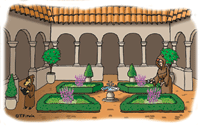
Getting Close to Cloisters

A garden can play many roles in our lives, depending on its design and intent: a treat for the senses, a source of sustenance, or a simple place to mess about with plants. But certainly one of the most important and traditional roles is as a unique place away from the world and worldly concerns. This special sort of garden can serve as an area for reflection, meditation, and spiritual healing. Indeed, for many of us, while we acknowledge having lost Eden, we haven’t given up on trying to recreate an ideal space for body and soul.

Perhaps no finer model for this meditation garden exists than the great monastic gardens which flourished for more than a millennium. By their very nature, these cloistered gardens were physically separated from the outside world by walls and roofed arcades, allowing visitors to focus within: both on the inner features of this peaceful garden, with its tranquil fountain, fruit trees, and healing herbs – and, more importantly, within themselves.

In fact, the very act of enclosing a garden reflects an almost primal understanding of what a garden is. For fun with philology, we can look to the etymology of “garden” and find the proto Indo-European root word “ghor-dho,” which means “enclosure.” (That word is also related to “yard” and the Latin hortus, as in horticulture.) Perhaps more interesting, medieval cloistered gardens were often called paradise gardens, hearkening back to Eden, with the word “paradise” coming to the West as pairidaeza, from the Old Persian, also meaning “walled enclosure.” The West, after all, did not have a monopoly on enclosed gardens.

To create a true garden meant separating your plants – and your person – from the world outside. And as our world is no more peaceful than that of the abbots who created the Benedictine and Cistercian monasteries, perhaps we might just want to return to the notion of a cloistered garden of our own.

Naturally, your three bedroom colonial might not easily lend itself to the addition of a finely cut stone-walled quadrangle, but you can at least separate your meditative space from the rest of your landscape with a simple wooden fence, trellises, arbors, or a planting of shrubs. You’re simply looking for a private inner space where you can turn within.

Following the lead of the monastic gardens, which typically observed a formal layout of rectangular beds and pathways, you might want to establish raised beds, another common medieval feature, in which to cultivate herbs and vegetables. After all, St. Benedict in the 6th century required that his monks provide all their own “necessaries” within the walls of their monastery. Not unlike the Victory Gardens of the 1940s.

Herbs were especially important to the monastic garden, as any fan of the Brother Cadfael mysteries knows. Medicinal plants were at the heart of monastic life, where monks studied and recorded the therapeutic properties of roots, dried leaves, and fruits, thereby institutionalizing modern pharmacology, much as the abbeys laid the groundwork for hospitals. Consider a quick visit to a public herb garden to identify medicinal and other herbs for your garden. You will be surprised that key medieval herbs are still favorites today.

Fruit trees, another symbol of paradise (munching on which led to man’s expulsion), were common features in almost all medieval gardens, and might adorn your garden, as well. Of course, barring the presence of a serpent, you should feel free to enjoy any of the apples or plums that you grow.

And while planning your bit of backyard paradise, remember that fragrance can stir memory and reflection, much as incense is used in both Eastern and Western religious traditions. Depending on your taste, you might plant soft musky-scented English boxwoods as a formal edge to your pathways, or choose from the palette of native shrubs and vines such as buttonbush or arbor-loving virgin’s bower.

The center of your garden should host a single, strong element, whether a trickling fountain, birdbath, or piece of sculpture. Original medieval works are probably out of the question, but concrete knock-offs of the Irish St. Fiacre (patron saint of gardeners) can be found in various garden shops, especially those associated with cathedrals, naturally.

Lastly, remember to set aside an area where you can actually sit and enjoy – and use – your meditation garden. That means setting aside time as well. The world goes along in its bumpy chaotic way, but you can still find a peaceful retreat and solace for your soul in paradise, even if it’s only in your backyard.

A personal note on cloistered gardens:
I strongly believe that at one time or other, nearly everyone has been profoundly influenced by a special place or an experience of place. For a young kid from Brooklyn, that place was the Cloisters in New York, the Metropolitan Museum of Art’s world-renowned and truly staggering collection of medieval art. The Cloisters is a museum woven around five actual monastic gardens disassembled and reassembled stone-by-stone in Ft. Tryon Park, overlooking the Hudson River. At around age 12, I experienced the Cloisters for the first time with my father one late winter’s day. I remember the scent of lemon and orange blossoms from potted trees dotting the glass-screened arcades; the burbling sound of fountains competing with Gregorian chant echoing through the complex. That single visit ultimately led to my educational life as a medievalist, my vocation as a horticulturist, and created a cultural passion that informs each and every moment of my life. Today, my wife (a medievalist) and I are on the verge of planning the construction of my dream home: it will have bedrooms, a kitchen, library, and all the rest – and it will be built around a central courtyard, a garden, with herbs and fruit trees and fountains. Evidently some places change you forever.

Copyright 2014, Joseph M. Keyser

Wednesday, August 13, 2014

Bamboozled by Bambusa

A common axiom in gardening is putting the right plant in the right place. Where bamboo is concerned, most people think that the only appropriate location is somewhere on the far side of hell. Bamboo is cherished and ardently defended as a vigorous landscape screen by some, although it is usually cursed as an invasive, unstoppable menace by most others, especially irate neighbors who find spikes and spears shooting up in their lawn and garden beds.

There are more than 750 species of bamboo plants which have been introduced to North America from Asia, the Caribbean, and Latin America. Most of these woody grasses (yes, they are actually grasses!) fall within the genera Bambusa, Pseudosasa, and Phyllostachys, and are renowned for growing upwards of 16 to 40 feet, with a cane or “culm” diameter ranging from one to six inches. Many also experience a general die-back after about a dozen years, usually after flowering, which will leave a dead, yellowed bamboo jungle, until new growth repopulates the grove.

Some species are considered “clumping,” which are generally well-behaved, while the more insidious specimens are called “running bamboos,” which will swiftly produce an impenetrable and monocultural thicket as they exert their own manifest destiny. Among the most commonly sold, planted, and (ultimately) loathed of runners is Golden Bamboo (Phyllostachys aurea).

These exotic invasive bamboos have caused feuds just shy of the infamous Hatfield and McCoy dust-up. Lawsuits have been filed, bulldozers mobilized, and concrete barriers poured. And yet, for all that, people looking to screen their yards from neighbors continue to plant running bamboos, especially in narrow spaces between properties or along fence lines.

Happily, there are attractive and non-invasive alternatives to bamboo blight, but first we should address how best to control and eradicate these invaders.

To keep bamboos from running, a rhizome barrier should be used. Bamboos very seldom produce seeds, and use rhizomes, or horizontal underground roots, to spread outward. To stop this march, a barrier two-three feet deep is essential, with about two inches rising above the soil surface. Slant the barrier outward near the top to ensure that rhizomes hitting your blockade will grow upward, and not down and eventually under the barrier. Keep an eye out and cut off any roots that attempt to grow over the top. Barriers can be made from metal or concrete, although heavy 60 mil plastic is the most readily available and affordable.

Clumps of bamboo can also be dug out, as the roots are actually quite shallow. Be sure to remove any and all pieces of the rootstock, including wayward rhizomes, and keep an eye out for future incursions.

A somewhat easier approach is to cut bamboo shoots as close to the ground as possible, and thereafter snip or mow down any new shoots or pesky regrowth. Eventually, you will starve the rootstock and the plant will die, although you will need to patrol the area on a regular basis for a year or so. This technique is best used on bamboo entering your yard from a neighboring property. In fact, some homeowners simply mow down any shoots in their lawns when they cut their grass, and have seen thumb-thick shoots eventually replaced by pencil-thin sprouts, just before they disappear altogether.

For quicker, more thorough results, Jan Ferrigan, an invasive plant program manager in Virginia, recommends cutting down bamboo shoots and applying Roundup or a similar glyphosate herbicide directly inside the now-open stem, and painting the outer surface of the culm. Jan suggests carefully using the herbicide at a 25 percent concentrated solution, not the typically diluted two percent used for routine spraying. And fall is the usually recommended time for application.

Naturally, the best solution is not to plant exotic bamboos at all. And the finest alternative is, not surprisingly, a native bamboo. Generally called canebrake bamboo (Arundinaria gigantea), or southern cane, this species used to cover enormous stretches of riparian “bottom land” from the mid-Atlantic to the Midwest prairies, down through the southeast, and along the Gulf states. Amazingly, before European colonization, native Americans lived among canebrake groves several miles in width, running up to 100 miles in length. Today, there are only scattered patches of these lush thickets.

Homeowners looking for a tall, dense, yet elegant, living fence need look no further. Canebrake can reach 12 to 18 feet or more, with half- to three-quarter inch canes and medium to dark green foliage year-round. However, when shopping around, don’t confuse this species with switch cane (A. tecta), which is smaller, low growing, and more suited as a groundcover plant. And while very few garden centers and nurseries seem to carry canebrake, there are numerous sources online and through mail-order catalogs, with prices ranging from 15 to 25 dollars for one and two gallon containers.

Not interested in bamboo at all? Consider arborvitae (Thuja occidentalis) as an alternate evergreen screen. The cultivar Emerald Green is probably the most popular of standard arborvitae, growing 15-20 feet, with a spread of four-six feet. Its lustrous gem-green foliage is tolerant of cold winters and hot summers, although, as a native of the northeast, it would prefer to be watered during dry periods, and mulched three to four inches deep to retain soil moisture.

Emerald Green can be pruned if or as desired in early spring, and is often considered superior to the much overused Leyland cypress, which could also work as a screen, although it can reach 60 feet and would require substantial pruning to achieve the same effect. Other desirable cultivars include both ‘Nigra,’ which remains dark green even through the winter, featuring a pyramidal form reaching 15-25 feet and five-eight feet wide, and ‘Pyramidalis,’ with softer, bright green needles, growing to 15 feet with a four foot spread.

Another clear winner is Irish juniper (Juniperus communis ‘Hibernica’) with bluish-green foliage, and a columnar form reaching 10-12 feet. This juniper is drought tolerant, with dense upright branches. Some nurseries indicate that it can reach 15 feet with only a narrow two-four foot spread.

There are also numerous species of yews suitable for narrow space screening. All are able to handle heavy pruning and shaping, and contrast their dark green foliage with bright, fleshy red or yellowish-red berries, called arils.

Perhaps most prized of all is Irish yew (Taxus baccata ‘Fastigiata’), which is actually an English or common yew, easily growing from 15-30 feet tall, with a four-eight foot spread. [It is the most commonly grown species in Europe, and has been in use for well over 200 years.] The needles are a striking blackish-green, although other cultivars, such as ‘Fastigiata Aurea,’ while similar in form, actually feature golden foliage on its new spring growth.

Japanese Yews (Taxus cuspidata) generally tend to have a broader spread and lower growth habit, and often quite a slow growth rate. However, cross Japanese and English yews and you’ll find a hybrid (Taxus x media) showcasing some of the best assets of each parent. Many of the outstanding cultivars for living screens were developed or discovered on my native Long Island, including several by famed nurseryman Henry Hicks. The specimen bearing his name, Hicks yew (Taxus x media ‘Hicksii’), is columnar in form, 12-20 feet high, and six-ten feet across, with glossy needles, deep green on top and a pale green underneath.

Lastly, Eastern hemlock (Tsuga canadenensis) has long be valued for its light, airy needles and graceful branches, which readily accommodate heavy pruning to create a lush, dense hedge. Left on its own, however, the tree will reach 60 feet with wider spaced branches.

Copyright 2014, Joseph M. Keyser