Monday, January 26, 2009

Catalogs Promise a Horticultural Heaven

Holiday catalogs barely seem to ebb in number before the typical gardener’s mailbox is filled with dozens of seed and garden catalogs bursting with gleaming copper obelisks, Chinese Giant Peppers, and a host of tantalizing plants, tools, and often wacky products.

Garden catalogs are the remedy for winter blues. Just turn a few pages and encounter luscious blueberries while the Arctic winds of winter howl. Pick up another catalog and the folks at Van Bourgondien will dazzle you with their “dinner plate” dahlias, each rainbow-tinted bloom larger than a cherubic child’s head.

Mail-order catalogs can also be important tools for the aspiring horticulturist seeking colorful dwarf conifers, heirloom vegetables, or disease resistant plant cultivars. Local garden centers, despite fine reputations and choice offerings, can never match the variety of plant and garden materials available through catalogs and Internet sources.

At one time, Barbara Barton’s classic Gardening by Mail: A Source Book, served as an unparalleled guide to mail-order garden suppliers. Now in its fifth edition, it is hard-challenged by the numerous compendia of catalogs found online. GardenGuides.com is a typical site which provides extensive listings of catalogs, ranging from traditional sources such as Burpee, Park Seeds, Stokes Seeds, and so on, to specialty growers and suppliers, such as Seeds of Change, the Antique Rose Emporium, or the Thomas Jefferson Center for Historic Plants. After all, who can hold a bulb to Bobba-Mike's Garlic Farm with 38 different strains of organically grown gourmet garlic? And your local nursery can never hope to rival the bloodthirsty inventory of Cook’s Carnivorous Plants.

If there is a niche to be filled, there is a catalog (or ten) available. For example, tomatoes are a mainstay of most vegetable gardens, and catalogs like Totally Tomatoes offer 80 pages of selections, from Big Zac Hybrids with fruits weighing in at four to six pounds each, to Micro Tom Hybrids, a six inch tall plant covered with pea-size fruits.

Gardeners who favor landscapes that are both tasty and unique have long found a champion in Mike McConkey’s Edible Landscapes, where hedges can be grown from currants and jostaberries, arbors covered by maple-red leafed Russian kiwis, and entryways brightened by Regent Juneberries. Similarly, Nichols Garden Nursery features a catalog of seeds, live herb plants, and other gourmet materials specifically grown for the gardener cook.

Some of the most stunning catalogs come from upscale nurseries like Bluestone Perennials, Logee’s Greenhouses, Wayside Gardens, and White Flower Farm. Each brilliant page is a siren call to rip up that boring old lawn and replace it with sweeping perennial beds shimmering with ruby, pink, and purple asters, or living mounds of white, salmon, and vermillion dianthus hybrids.

Catalogs range in feel and style as much as in plant or product selections. R.H. Shumway’s Illustrated Garden Guide is an oversize publication rich in tradition, where engraved plate illustrations harken back to the company’s origins 133 years ago. More homespun and academically-oriented nurseries such as Garden Medicinals and Culinaries only print a catalog every several years and rely on black and white photocopied updates to announce the availability of endangered species like Blue Cohosh, sweet-scented Vanilla Grass or Black Hollyhocks from the pre-1830s.

Naturally, gardens require more than seeds and plants. The multi-billion dollar world of garden equipment supplies, from hose reels, garden carts, and do-it-yourself greenhouses, includes respected firms like Gardener’s Eden and Smith and Hawken, while a less expensive and personal favorite, Gardener’s Supply Company, long famous for its compost bins, planters, garden ornaments, and seed-starting supplies offers a catalog echoing its corporate mantra of non-toxic pest control and organic gardening techniques.

Of course, Gardener’s Supply is in good company with Garden’s Alive, Necessary Organics, and a host of firms dedicated to resource conservation and environmental solutions to pests and other problems.

The world of garden accessories has some distinctly kitschy byways. Upscale catalogs offer Parisian street lamps, topiary forms, plantation grown teak furnishings, or enameled Mexican chimenea, while further down the rabbit hole we find garden sculpture crafted from dried cow manure, human-scale outdoor chess sets, faux marble statuary, vinyl balustrades, and the Amazing Floating Gazebo which “appears to float in your yard!”

With a new gardening season on its way, consider some of the creative possibilities which are just a few catalog pages, mouse-clicks, and credit card charges away. Surprise mom on Mother’s Day with a Clara Barton Redbud from the Historic Trees Nursery, a hand-painted hummingbird feeder, or perhaps a miniature tree rose from Tiny Petals Nursery. If you can still recall conditions last summer, you might want to treat yourself to the catalog of High Country Gardens, which offers hundreds of drought tolerant, xeriscape plants, along with design plans.

Catalogs can help you go solar, with solar-powered sprays for fountains, walkway lighting, or patio accent lights. They can help you save water with rain barrels and drip irrigation supplies. They can help you find unusual plants, attractive rain gauges, or reasonably priced sundials.

Or you can simply turn your back on good taste and respectability and either purchase a flock of pink flamingos or choose from one of the many catalogs featuring dozens of garden gnomes involved in mostly PG-rated activities.

Copyright 2009, Joseph M. Keyser

Saturday, January 03, 2009

Meditations on a Monastic Garden

A garden can play many roles in our lives, depending on its design and intent: a treat for the senses, a source of sustenance, or a simple place to mess about with plants. But certainly one of the most important and traditional roles is as a unique place away from the world and worldly concerns. This special sort of garden can serve as an area for reflection, meditation, and spiritual healing. Indeed, for many of us, while we acknowledge having lost Eden, we haven’t given up on trying to recreate an ideal space for body and soul.

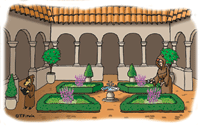
Perhaps no finer model for this meditation garden exists than the great monastic gardens which flourished for more than a millennium. By their very nature, these cloistered gardens were physically separated from the outside world by walls and roofed arcades, allowing visitors to focus within: both on the inner features of this peaceful garden, with its tranquil fountain, fruit trees, and healing herbs – and, more importantly, within themselves.

In fact, the very act of enclosing a garden reflects an almost primal understanding of what a garden is. For fun with philology, we can look to the etymology of “garden” and find the proto Indo-European root word “ghor-dho,” which means “enclosure.” (That word is also related to “yard” and the Latin hortus, as in horticulture.) Perhaps more interesting, medieval cloistered gardens were often called paradise gardens, hearkening back to Eden, with the word “paradise” coming to the West as pairidaeza, from the Old Persian, also meaning “walled enclosure.” The West, after all, did not have a monopoly on enclosed gardens.

To create a true garden meant separating your plants – and your person – from the world outside. And as our world is no more peaceful than that of the abbots who created the Benedictine and Cistercian monasteries, perhaps we might just want to return to the notion of a cloistered garden of our own.

Naturally, your three bedroom colonial might not easily lend itself to the addition of a finely cut stone-walled quadrangle, but you can at least separate your meditative space from the rest of your landscape with a simple wooden fence, trellises, arbors, or a planting of shrubs. You’re simply looking for a private inner space where you can turn within.

Following the lead of the monastic gardens, which typically observed a formal layout of rectangular beds and pathways, you might want to establish raised beds, another common medieval feature, in which to cultivate herbs and vegetables. After all, St. Benedict in the 6th century required that his monks provide all their own “necessaries” within the walls of their monastery. Not unlike the Victory Gardens of the 1940s.

Herbs were especially important to the monastic garden, as any fan of the Brother Cadfael mysteries knows. Medicinal plants were at the heart of monastic life, where monks studied and recorded the therapeutic properties of roots, dried leaves, and fruits, thereby institutionalizing modern pharmacology, much as the abbeys laid the groundwork for hospitals. Consider a quick visit to a public herb garden to identify medicinal and other herbs for your garden. You will be surprised that key medieval herbs are still favorites today.

Fruit trees, another symbol of paradise (munching on which led to man’s expulsion), were common features in almost all medieval gardens, and might adorn your garden, as well. Of course, barring the presence of a serpent, you should feel free to enjoy any of the apples or plums that you grow.

And while planning your bit of backyard paradise, remember that fragrance can stir memory and reflection, much as incense is used in both Eastern and Western religious traditions. Depending on your taste, you might plant soft musky-scented English boxwoods as a formal edge to your pathways, or choose from the palette of native shrubs and vines such as buttonbush or arbor-loving virgin’s bower.

The center of your garden should host a single, strong element, whether a trickling fountain, birdbath, or piece of sculpture. Original medieval works are probably out of the question, but concrete knock-offs of the Irish St. Fiacre (patron saint of gardeners) can be found in various garden shops, especially those associated with cathedrals, naturally.

Lastly, remember to set aside an area where you can actually sit and enjoy – and use – your meditation garden. That means setting aside time as well. The world goes along in its bumpy chaotic way, but you can still find a peaceful retreat and solace for your soul in paradise, even if it’s only in your backyard.
A personal note on cloistered gardens:
I strongly believe that at one time or other, nearly everyone has been profoundly influenced by a special place or an experience of place. For a young kid from Brooklyn, that place was the Cloisters in in New York, the Metropolitan Museum of Art’s world-renowned and truly staggering collection of medieval art. The Cloisters is a museum woven around five actual monastic gardens disassembled and reassembled stone-by-stone in Ft. Tryon Park, overlooking the Hudson River. At around age 12, I experienced the Cloisters for the first time with my father one late winter’s day. I remember the scent of lemon and orange blossoms from potted trees dotting the glass-screened arcades; the burbling sound of fountains competing with Gregorian chant echoing through the complex. That single visit ultimately led to my educational life as a medievalist, my vocation as a horticulturist, and created a cultural passion that informs each and every moment of my life. Today, my wife (a medievalist) and I are on the verge of planning the construction of my dream home: it will have bedrooms, a kitchen, library, and all the rest – and it will be built around a central courtyard, a garden, with herbs and fruit trees and fountains. Evidently some places change you forever.

Copyright 2009, Joseph M. Keyser

Sunday, December 14, 2008

Discovering the Secrets of Papyrus

In recent years, ornamental grasses have become de rigueur for most modern garden designs. They are graceful, tall, and elegant – rather much the Audrey Hepburn of horticulture. But how can we translate this vertical effect to our indoor gardening environment? The solution comes replete with a rich and stunning history dating back to the ancient Nile, Pharaohs, Egyptian gods, and Moses in the bulrushes. Welcome to papyrus, one of the most important plants in early human civilization.

Papyrus (Cyperus papyrus), is undoubtedly the most famous member of the genus Cyperus (kupeiros is Greek for sedge), which is comprised of some 4,000 to 5,000 species, several of which are well-suited for indoor and outdoor pond gardens. The species name papyrus derives from the Egyptian word meaning “that which belongs to the house,” where house alludes to the ancient ruling body or bureaucracy.

Papyrus is, of course, the source for our word paper, and was also the plant used to produce sheets of paper for thousands of years, beginning as early as 4,000 BC. In fact, a thriving and vital trade existed for this writing material until about the third century AD, when it was found easier to produce paper from plant pulp, in a process introduced into the Middle East from China via Arab traders. Papyrus-paper also faced competition from Europe and the Near East in the form of parchment or vellum, which was made from animal skins, such as calf or sheep (hence getting your diploma or “sheepskin”). Papyrus continued to be manufactured and used in ever-decreasing amounts until the 11th century.

Interestingly, the plant itself all but disappeared from Egypt during the 20th century, due to dams on the Nile and other unsustainable practices. The plants were reintroduced into the area around Cairo from thriving native plant stock in Ethiopia and the Sudan in the late 1960s by Dr. Hassan Ragab, an Egyptian inventor and scientist, who also rediscovered a method for creating papyrus, which has now reemerged as a high-end novelty product and specialty paper.

Papyrus was, however, much more than an everyday paper product. Ancient Egyptians would also use the soft pith of the stem as a foodstuff, cooked and processed like sugar cane, or eaten raw. Ancient pharmacologists, like Galen and Dioscorides, cataloged a wide variety of medicinal uses for infusions made from the plant. Egyptians also harvested and dried the woody rhizomes and culms to use as a fuel – whose ashes were also medicinal! Garlands were woven from the graceful flower heads to adorn the shrines of the gods, and for funeral observances. The stylized representation of the papyrus inflorescence, or umbel, is a central motif in the art of the period, akin to the lotus motif in Eastern art. Fibrous strands taken from the stem of the plant were used to weave sandals, ropes, plaited fans, mats, wrapping materials, and to produce, oh yes, baskets.

Lest we forget, the basket into which Mariam and Jochebed placed the infant Moses to escape the infanticide decree of Pharaoh was woven from papyrus stems. And, as you think of sister Mariam watching the basket float along the Nile and nestle into the bulrushes, keep in mind that bulrush is but another common name for papyrus. Holy Moses!

Today, papyrus can find a ready welcome far from the subtropical banks of the Nile, especially as there are closely related species of sedge which can readily fit into a water garden, pond, or even into an attractive indoor container. Actually, the true papyrus species is overwhelming, and might be more bulrush than you can handle. Under ideal conditions, Cyperus papyrus can grow between 12 and 15 feet tall, with stems approaching six inches in diameter, although most gardeners report that indoors the plant only reaches eight feet. Still, that might be a bit much for the average family room. And don’t forget that all of the papyrus-like species originated in tropical and subtropical climes, and will need to be relocated indoors before the first frost.

A species suitable for the average backyard water feature is dwarf papyrus or miniature cyperus (Cyperus prolifer), which will stay upright and well-ordered at no more than 12 to 36 inches. Like most Cyperus, the plant thrives in full sun and likes to sit in water. Pretty ideal, having a plant that cannot be overwatered! This species can also take light to partial shade in the yard, or will purr happily in a sunny indoor window.

Pygmy Egyptian papyrus (C. haspan) has a sparkling appearance much like a bright green feather duster. It will top out at about 18 inches, and feels at home in a pot filled with a rich, loose soil mix, which is then placed in a second larger container filled with water – or set into an outdoor pond.

My personal favorite Cyperus species actually hails from Madagascar, and while it bears some overall resemblance to papyrus, its leaves are thicker and lie in a flat plane, which easily led to its common name, umbrella plant (C. alternifolius).

Umbrella plant can grow to five feet or more indoors, and slightly larger outdoors, although three to five feet is more common. Another sedge, it has a triangular stem, whose shape lends structure support to keep the stem upright in strong winds, perhaps faring better than the average umbrella. It also loves to sit in water day after day.

In fact, many of us who fancy the plant actually grow it in nothing more than a cachepot or sealed container filled with water, and lined with rocks on the bottom to help stabilize plant roots. In this hydroponic setting, it’s important to fertilize somewhat regularly, especially during active growing and flowering periods. But don’t mind the flowers: nothing much exciting there, mostly a bland, tan, oat-shaped affair.

Like most sedges, umbrella plants can be propagated by dividing the substantial root masses or clumps of rhizomes, keeping the outer, younger sections for replanting, and composting the older core. Although a much more entertaining method, of which I have not tired in more than 20 years, calls for cutting off the top six inches of a stem of the plant, leaves and all, and inverting the whole into a glass or vase of water. After a few weeks, roots will form around the junction of leaves and stem, and new shoots will emerge growing up, out of the water. When well-established, carefully plant the rooted cutting into a loose soil mix and keep well watered – or immersed. You can also continue to let the plant grow in water alone.

For the record, several plants gracing the bookcases in my office are descendants from several cuttings given to me in 1979. They have, over the years, produced huge clumps of plants for my rooftop garden, and smaller, discrete potted specimens for windowsills. Scores have been propagated and given to friends and curious visitors. And the tradition lives on.

Like the Egyptian papyrus alternatives, umbrella plants are available in compact and dwarf varieties, such as sparkler grass (C. alternifolius gracilis) under 18 inches with delicate, narrow leaves, as well as in a related variegated form (C. diffusus variegatus), where both leaves and stems are striped with a touch of creamy white against a wide, light green leaf.

Whether you’re striking out to honor Osiris, or print your own Book of the Dead on homemade papyrus, or maybe just add a little excitement to your parlor window with a dwarf ‘Nana’ umbrella plant, you can find just the right plant through online sources year-round, while many fine garden centers sell potted specimens in their water garden section.

Copyright 2008, Joseph M. Keyser

Thursday, September 04, 2008

A Peaceful Urban Setting at Fort Georgetown

From The Washington Post:

Horticulturist Joe Keyser does not have to deal with the pesky deer that are the bane of many Washington area gardeners -- he grows his 30 varieties of herbs, 15 types of lavender and other assorted greenery four stories above the streets of Rosslyn.

Keyser, an environmental education specialist who writes a gardening column for the Gazette newspapers in Maryland, has lived in Arlington's Fort Georgetown apartments for 20 years. You might think a gardening expert would yearn for a yard, but he doesn't.

"Through my work I have surrogate gardens all over, but I find container gardening more of a challenge, giving me a chance to grow something more tropical," said Keyser, whose rooftop deck measures 15 feet by 26 feet. Mature trees surround his corner apartment, adding another verdant touch to the deck, even though it is within sight of Rosslyn's concrete high-rises.

"We get hummingbirds up here," he said, along with the inevitable squirrels. "They bury their acorns and forget them. Oak trees pop up in even the smallest containers."

>> Read the complete story: click here.

Wednesday, July 30, 2008

Protect A National Treasure

Urge Congress to Pass the Great Lakes Water Resources Compact

The Great Lakes are in danger of depletion from commercial interests hooking up pipelines and sending tankers to take water out of the basin. Although the Great Lakes basin contains nearly 20 percent of the earth’s fresh surface water, rainfall and snowmelt replenish only about one percent of the water in the basin each year. The rest is finite and nonrenewable. There is a growing demand for water by utilities, agriculture, manufacturers, and residents throughout the region. As regional demand increases, there is growing pressure to divert water from the Great Lakes to other regions and even to other countries. Current laws are not strong enough to protect the Great Lakes and maintain enough water to meet the needs of residents and wildlife in the region.

Congress must approve the Great Lakes Water Resources Compact to protect our Great Lakes and the people, fish, wildlife, outdoor recreation, and economic interests that depend on them. All eight Great Lakes states have already ratified the compact, agreeing on a set of rules that everyone will follow to protect the Lakes. Ontario and Quebec have also approved an agreement with the same rules. Now, Congress must pass the Great Lakes Water Compact to finalize it.

It is vital that members of Congress hear from supporters both within and outside the Great Lakes region that we want them to protect this national treasure. Please urge your Representative and Senators to vote for the Great Lakes Water Resources Compact.

CLICK HERE to take action now!